


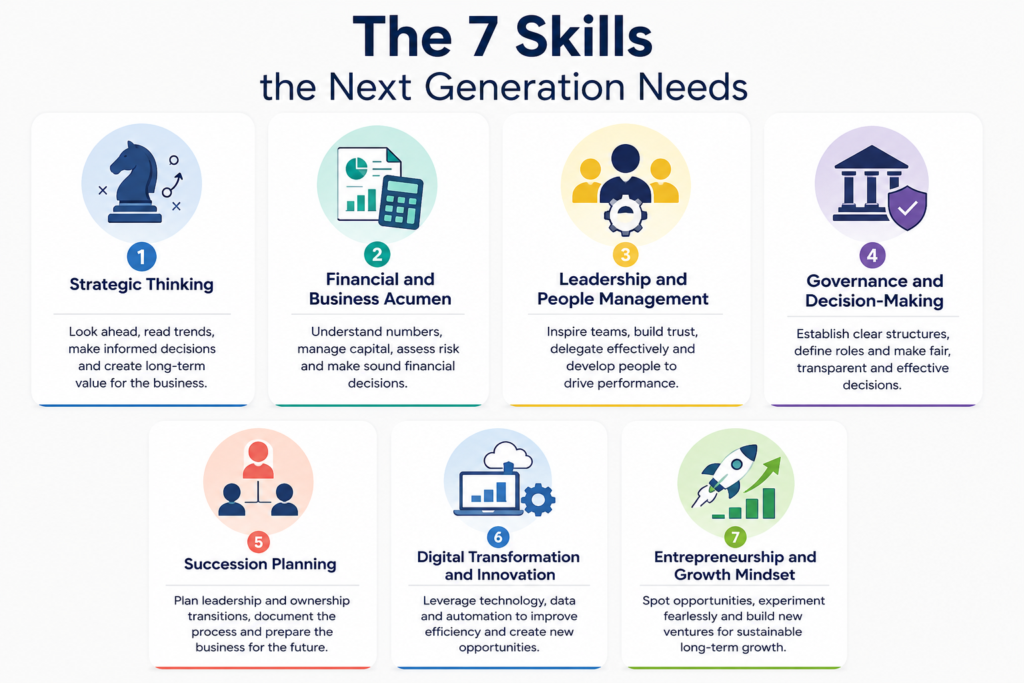
Before taking charge, the next generation needs to build a specific set of family business management skills: strategic thinking strategic thinking, financial and business acumen, leadership and people management, governance and decision-making, succession planning, digital transformation, and an entrepreneurial growth mindset. None of these come automatically with a family surname — they have to be built deliberately, often outside the comfort of the family’s existing playbook.
That single sentence answers the search query. The rest of this article explains why each of these matters, what “professionalising” a family business actually looks like in practice, and how structured learning fits into that preparation.
Taking Over a Family Business Is More Than Inheriting a Position
A family business handover is often talked about as a single event — the day the founder hands over the keys. In practice, it is a multi-year process that touches ownership, management, and family relationships at the same time, and each of these can move at a different pace.
PwC’s Indian Family Business Survey found that 73% of next-generation family members already work in the family business, a higher share than the 65% recorded globally. That statistic matters because it means most successors are not stepping into an unfamiliar company — they are trying to change how a company they already know operates, which is arguably harder than starting fresh.
The confusion that trips up many successors is treating “taking over” as inheriting a title rather than earning operational and strategic credibility. A designation can be handed over in a board resolution. Trust from employees, vendors, bankers, and family elders cannot — it has to be demonstrated.
The 7 Family Business Management Skills the Next Generation Needs
1. Strategic Thinking
Strategic thinking is the ability to look beyond the current product line, customer base, or geography and ask where the business needs to be in five or ten years — and what has to change today to get there. First-generation founders often built the business reactively, seizing opportunities as they appeared. The next generation typically needs to formalise that instinct into a deliberate strategy: which markets to enter, which to exit, and where capital should be allocated.
This includes reading industry trends, understanding competitive positioning, and being comfortable with scenario planning rather than only operational firefighting.
2. Financial and Business Acumen
Financial literacy for a family business leader goes beyond reading a profit and loss statement. It includes understanding working capital cycles, cost of capital, valuation, and how family drawings and business reinvestment compete for the same cash. Many family businesses in India remain reliant on informal financing and personal guarantees; a successor who understands formal capital markets, structured debt, and investor expectations can open doors the previous generation could not.
PwC’s India research also found that 89% of family-owned businesses in the country use bank loans and credit lines to fund the business, while 56% said they would look at private equity funding. A successor who can evaluate and negotiate both routes has a genuine advantage over one who only understands traditional bank financing.
3. Leadership and People Management
Leading a family business means managing two overlapping groups: family members with informal authority and non-family professionals with formal roles. Successors need people-management skills that a founder may never have needed, because founders typically built loyalty through personal relationships over decades. A next-generation leader has to earn that same loyalty faster, and often from professionals who are more experienced or older than they are.
This requires structured skills — delegation, performance management, conflict resolution, and communicating a vision to people who did not build the company from scratch.
4. Governance and Decision-Making
Governance is the set of rules and structures that decide who has authority over what, and how disputes get resolved. Family businesses without clear governance tend to let personal relationships substitute for process, which works until the family disagrees about something significant.
A family constitution, a defined board structure (even if informal), clear roles for family versus non-family members, and documented decision rights are not corporate formalities — they are what allows a business to survive disagreement without it becoming a crisis.
5. Succession Planning
Succession planning is often assumed to mean “who becomes the next CEO,” but it is broader: it covers ownership transfer, leadership transition, tax and legal structuring, and preparing the rest of the organisation for change. This is consistently the area where Indian family businesses are weakest.
Only 21% of family businesses in India have a robust, documented and communicated succession plan in place, according to PwC’s research, even though 60% say they intend to pass on management or ownership to the next generation. That gap between intent and preparation is where most transition failures originate — not in a lack of willingness, but in a lack of documented process.
6. Digital Transformation and Innovation
Legacy processes that worked for decades can become a liability when competitors digitise faster. PwC’s 12th Global Family Business Survey found that 39% of Indian family businesses are now prioritising digital transformation and AI, compared with 24% globally — a sign that Indian family enterprises increasingly see technology as a growth lever rather than a back-office upgrade. Next-generation leaders are often the natural champions of this shift, since they typically bring more comfort with data, automation, and digital-first customer engagement than the generation before them.
7. Entrepreneurship and Growth Mindset
Even in an established business, the next generation benefits from thinking like a founder — spotting adjacent opportunities, being willing to test and fail on a small scale, and resisting the temptation to only protect what already exists. Indian family businesses reported unusually strong growth ambition in PwC’s most recent survey, with 55% planning to expand aggressively, compared with just 16% of family businesses globally. That ambition needs an entrepreneurial skill set to convert into results, rather than remaining aspirational.
How Can the Next Generation Professionalise a Family Business?
Professionalising a business is really the practical application of the family business management skills at scale. It does not mean removing the family from the business; it means making the business less dependent on any single individual’s informal judgement.
Practical steps include:
| Step | What it involves |
| Document processes | Convert tribal knowledge (how decisions are actually made) into written policy |
| Separate family and business forums | Family matters and business matters get discussed in different meetings |
| Bring in outside professionals | Hire for roles the family cannot fill competently, and give them real authority |
| Formalise financial reporting | Move to audited, timely, standardised financial statements |
| Create a family constitution | Define entry criteria, roles, dividend policy, and dispute resolution in writing |
PwC’s earlier India survey found that 72% of family businesses expected to bring in non-family professionals within five years, and this remains one of the clearest markers of professionalisation in progress.
How to Prepare for Family Business Succession
Succession preparation works best as a phased process rather than a single handover meeting:
- Start early. Successors who spend a few years in a different company or industry before joining the family business often bring outside perspective and credibility that internal hires lack.
- Define the timeline explicitly. Vague plans (“whenever I feel ready to step back”) create uncertainty for employees, lenders, and the successor.
- Separate ownership from management. A successor can hold equity without necessarily being CEO — and vice versa. Conflating the two limits flexibility.
- Build a working relationship with the outgoing generation. The most difficult successions are not about capability; they are about the emotional transition of a founder letting go.
- Put it in writing. A documented succession and governance plan, reviewed periodically, is what separates intent from execution.
Common Mistakes Next-Generation Family Business Leaders Make
- Assuming authority follows title. A designation does not automatically bring the trust of long-serving employees or vendors.
- Changing too much, too fast. Successors who dismiss the existing culture wholesale often lose institutional knowledge and loyalty in the process.
- Avoiding difficult family conversations. Succession, compensation, and roles for multiple siblings or cousins are uncomfortable topics that tend to get worse, not better, when postponed.
- Underinvesting in formal learning. Operating experience inside one company is valuable but narrow; it rarely exposes a successor to how governance, financing, or digital strategy work elsewhere.
- Treating governance as optional. Informal decision-making that worked for a small business tends to break down as the business, and the family, grow larger.
Should You Consider a Family Business Management Programme?
Not every successor needs a formal programme — plenty learn effectively through mentorship, industry bodies, or on-the-job experience. But structured learning tends to help in three specific situations: when a successor has limited exposure to formal finance, strategy, or governance frameworks; when the business is at an inflection point (scaling, professionalising, or entering succession); or when the successor wants structured peer exposure to other family businesses facing similar issues, rather than learning in isolation.
A good programme does not replace operating experience. It compresses the learning curve on the technical and governance skills that are hard to pick up purely from working inside one company, and it creates a peer group of other next-generation leaders navigating comparable transitions.
IIM Indore’s Family Business Management & Entrepreneurship Programme

Not every successor needs a formal programme to build these family business management skills, the Post Graduate Certificate Programme in Family Business Management & Entrepreneurship (FBME) at IIM Indore is built specifically around the skills covered in this article.
Programme Facts:
- Duration: 12 months, delivered live online on Saturdays with three on-campus modules (9 days total) at the IIM Indore campus
- Eligibility: Minimum 2 years of work experience and 50% marks in undergraduate/postgraduate study
- Curriculum: Structured across three modules covering strategic management, corporate governance, financial management, legal aspects of family businesses, change management and succession planning, leadership in family businesses, HR and operations in family businesses, growth strategy, and a capstone project applying the learning to the participant’s own business
- Programme Director: Prof. Punyashlok Dwibedy, who holds a PhD in Strategy from IIM Ahmedabad and has co-authored a published case study on a family business acquisition
- Institute credentials: IIM Indore holds Triple Crown accreditation (AACSB, AMBA, EQUIS) and was ranked 5th among IIMs in the QS Global MBA Rankings 2024
The curriculum maps directly onto the family business management skills discussed above — governance and succession planning are taught as dedicated modules rather than side topics, which is relatively uncommon in general management programmes.
This is one option among several for structured learning, and it will suit some successors more than others depending on where they are in the transition and what specific gaps they are trying to close.
Frequently Asked Questions
What is the biggest skill gap for next-generation family business leaders in India? Succession and governance planning is consistently the weakest area. Only 21% of Indian family businesses have a documented, communicated succession plan, even though most intend to hand over the business.
Do I need an MBA to take over a family business? No. A full-time MBA is one route, but many successors are better served by a shorter, focused executive programme that covers governance, succession, and family-business-specific challenges without stepping away from the business for two years.
How long does succession planning usually take? There is no fixed timeline, but advisors generally recommend starting the formal process several years before an actual handover, since it involves not just leadership transition but ownership structuring, tax planning, and preparing the wider organisation.
Is professionalising a family business the same as losing family control? No. Professionalising means introducing formal systems and, where needed, non-family talent — the family can retain ownership and strategic control while delegating operational execution to capable managers, family or otherwise.
What is the difference between a family business management programme and a general MBA? A general MBA covers broad management theory. A family business-specific programme adds modules on succession planning, family governance, and the unique dynamics of running a business where ownership and management overlap with family relationships — topics a standard MBA typically does not cover in depth.
Conclusion
Taking over a family business is a longer and more layered process than the moment of formally assuming a title. The successors who navigate it well tend to combine operating knowledge of their own business with deliberately built family business management skills in strategy, finance, finance, governance, and succession planning — skills that are rarely acquired by default, no matter how many years someone has spent around the business growing up.
If you are preparing for this transition and want structured exposure to these skills alongside other next-generation leaders working through similar challenges, it may be worth exploring a dedicated family business management programme rather than relying on on-the-job learning alone.
For More similar blogs:Family Business Management Courses , Best Family Business Management Course in India