

Every family business eventually faces the same quiet, uncomfortable question: what happens when the person who built it is no longer the one running it?
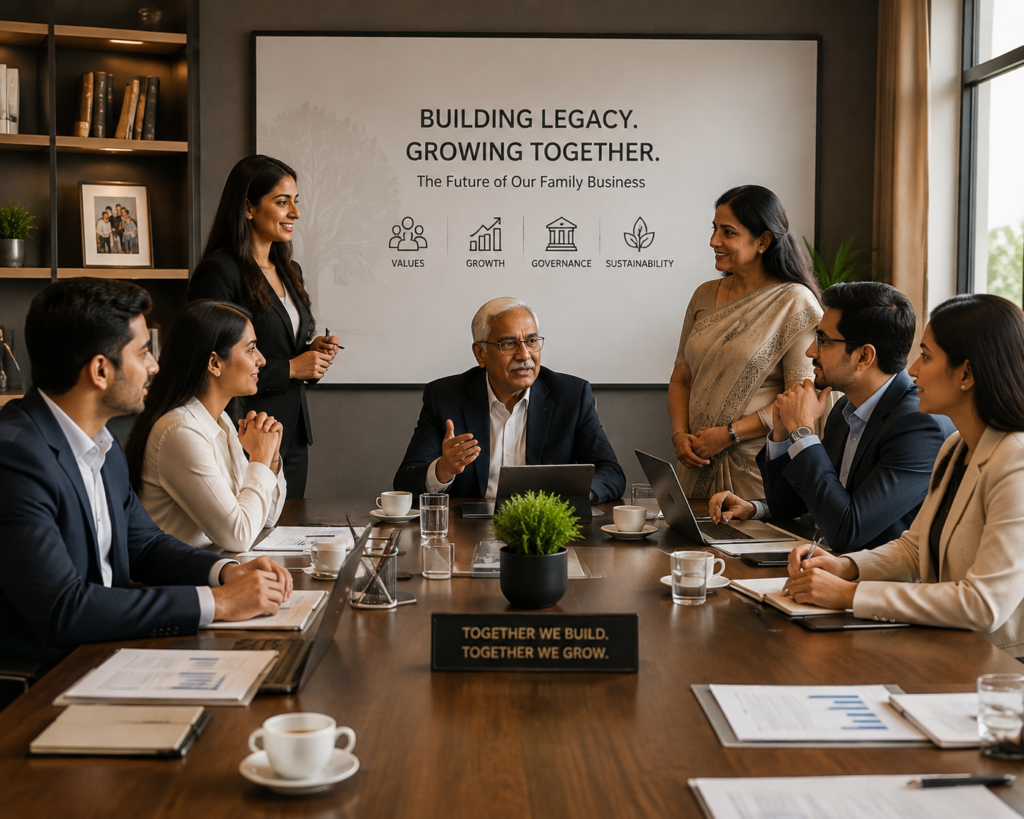
It rarely arrives as a single dramatic moment. More often, it shows up as a founder who is tired but doesn’t trust anyone else with the bank relationships. A daughter with an MBA who is expected to “just learn on the job” instead of being given real authority. A board meeting that is really a family dinner table argument wearing a suit. If any of this sounds familiar, you are not managing a business problem you are managing a transition, and transitions need structure that most owners were never taught.
This guide is written for people who are living that transition right now: business owners, founders, and next-generation successors trying to figure out whether a formal family business management course is worth their time, and if so, how to pick the right one. It walks through why family enterprises need a different kind of education than a standard MBA, what a genuinely useful programme should cover, how to evaluate the options in India, and where IIM Indore’s Post Graduate Certificate Programme in Family Business Management & Entrepreneurship (FBME) fits into that picture.
Key Takeaways
- Family businesses face a distinct set of challenges governance, succession, and family dynamics layered on top of ordinary strategy and finance that general management education rarely addresses head-on.
- A strong family business programme should combine governance and succession frameworks, entrepreneurial and growth strategy, and structured peer learning with people who are living the same transition.
- India’s family enterprises are entering a significant multi-generational leadership transition over the coming decade, making structured preparation increasingly relevant.
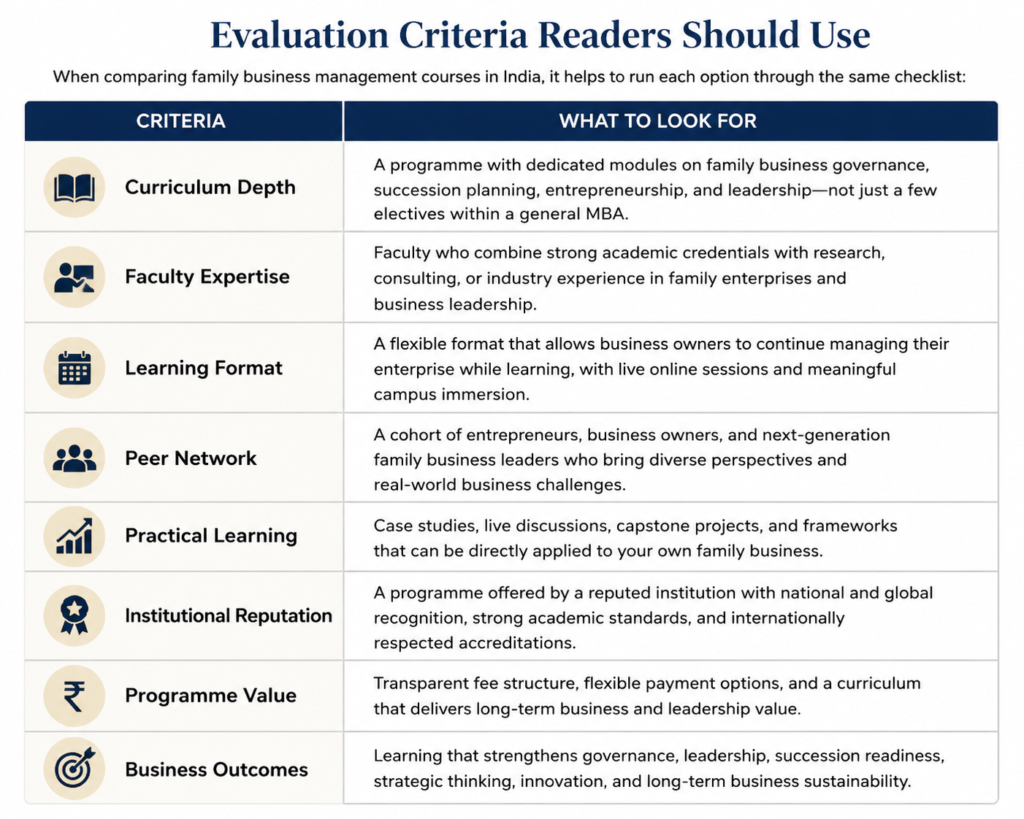
- When evaluating programmes, weigh faculty credibility, curriculum depth on governance and succession, delivery format against your work schedule, peer cohort quality, and institutional accreditation.
- IIM Indore’s FBME programme is purpose-built for entrepreneurs, owners, and next-generation leaders, combining live online sessions with on-campus immersion and a capstone project applied to the participant’s own enterprise.
Why Managing a Family Business Is Different From Managing Any Other Business
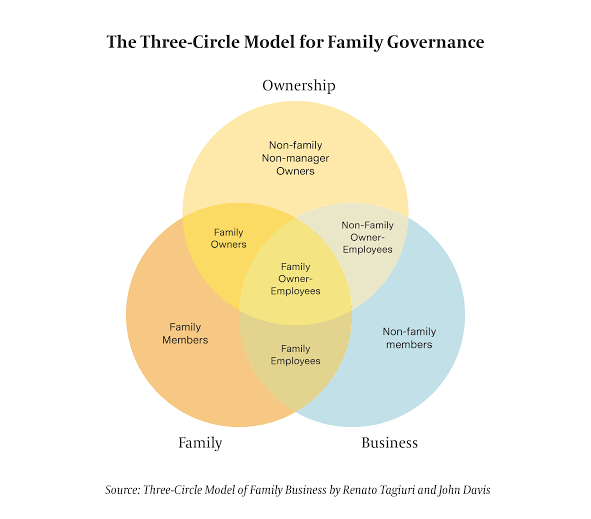
In a professionally managed company, authority generally follows structure: title, function, reporting line. In a family enterprise, authority also follows relationships who is the eldest, who married in, who was promised what twenty years ago at a wedding. Two systems, ownership and family, sit on top of the business at once, and decisions that look purely commercial from the outside are rarely that simple from the inside.
This is why a family business often struggles with problems a professionally run competitor would resolve in a single meeting. Should a non-performing family member stay on the payroll? Should the business expand into a new category the founder distrusts? Who actually has the final word on a large capital decision the person with the title, or the person with the seniority? None of these are pure finance or strategy questions. They are governance questions, and most family businesses never build the governance muscle to answer them cleanly.
Challenges Modern Family Businesses Face
A few pressures show up again and again across Indian family enterprises, regardless of sector or size:
- Succession without a plan. Leadership often changes hands through age or health rather than through a deliberate, agreed process, which creates uncertainty for employees, lenders, and customers alike.
- Governance that lives in someone’s head. Decision rights, dividend policy, and conflict resolution are informal, which works until the family disagrees — and then there is no mechanism to fall back on.
- Professionalisation resistance. Bringing in outside managers, formal reporting, or independent directors can feel like a loss of control rather than a source of strength.
- Generational friction over technology and growth. Founders who built the business on relationships and instinct can be wary of digital transformation, data-driven decision-making, or new business models that the next generation wants to pursue.
- Wealth and ownership tangled with management. Who owns equity and who runs operations are often the same small group of people, with no separation between the two roles.
None of these challenges are unique to India, but they show up with particular intensity here, given how much of the economy is built on family-owned enterprise and how many businesses are now approaching a leadership handover at the same time.
Why General MBAs Often Don’t Address These Challenges
A general MBA is designed to build broad managerial competence — strategy, finance, marketing, operations — for people who will typically work inside someone else’s organisation, climbing a corporate hierarchy. That’s valuable, but it isn’t built around the specific problem a family business owner actually has: how do you run a company where ownership, family identity, and management authority all overlap, and where the “org chart” is really a family tree?
A generic programme will teach you how to build a five-year strategic plan. It usually won’t teach you how to build that plan when your co-founder is also your uncle, and disagreeing with him in front of the leadership team carries a social cost a hired executive would never face. Succession planning, family constitutions, ownership transition structures, and the softer work of aligning family values with business strategy are simply outside the scope of most MBA curricula and yet, for a family enterprise, they are often the difference between the business surviving the next handover and not.
What Makes a Best Family Business Management Course in India
Based on what actually helps owners and successors navigate real transitions, a genuinely useful programme should combine several elements:
- Governance and succession frameworks — practical tools for designing decision rights, family constitutions, and leadership transition pathways, not just theory.
- Entrepreneurial and growth strategy — corporate strategy, brand building, digital transformation, and innovation, taught with an eye toward scaling a legacy business rather than launching a startup from zero.
- Financial and analytical rigour — financial management, valuation, investment and venture financing, and data-driven decision-making.
- Family dynamics and leadership — structured space to think through how family relationships intersect with business decisions, ideally through case discussion rather than generic soft-skills training.
- A peer cohort of genuine successors and owners — learning alongside people solving the same problem is often as valuable as the curriculum itself.
- Applied, enterprise-specific work — a capstone or project that participants apply directly to their own business, not a generic case study disconnected from their reality.
- Institutional credibility — faculty and accreditation that lend weight to what participants bring back to their boardrooms and their families.
Comparison of Leading Family Business Programmes in India
India’s top business schools have increasingly recognised the need for family-business-specific executive education, and several IIMs and premier institutes now offer dedicated programmes in this space, generally structured as certificate or diploma-level executive offerings rather than full-time degrees. These programmes typically share a common backbone governance, succession, strategy, and finance while differing in delivery format (fully online, hybrid, or campus-based), duration (ranging from a few months to a year or more), cohort size, and the extent of on-campus immersion.
When comparing options, it’s worth looking closely at three things beyond the marketing brochure: how much of the curriculum is genuinely built around family business governance and succession versus repackaged general management content; how much direct interaction participants get with faculty and peers rather than pre-recorded content; and whether the programme culminates in something applied to the participant’s own enterprise. Programmes that combine live faculty engagement, a meaningful on-campus component, and an enterprise-specific capstone tend to translate more directly into decisions a participant can actually take back to their business.
Why IIM Indore FBME Stands Out
IIM Indore’s Post Graduate Certificate Programme in Family Business Management & Entrepreneurship — currently enrolling its fourth batch — is built specifically around the problem this guide has been describing: how to lead a family enterprise through professionalisation, governance, and generational transition without losing what made it work in the first place.
A few things about the design are worth noting for anyone evaluating it against alternatives:
- Purpose-built, not repurposed. The programme is explicitly designed for entrepreneurs, proprietors, and next-generation leaders of family enterprises, rather than being a general management programme with a family business module bolted on.
- Three integrated modules. Management Practices for Entrepreneurs covers strategic management, corporate governance, financial management, and legal aspects of family businesses, alongside change management and succession planning. Business Landscape for Entrepreneurs covers corporate strategy, leadership and HR in family businesses, and digital and data-driven marketing. Entrepreneurial Success covers growth strategy, business models, risk management, taxation, and culminates in a capstone project.
- Applied capstone. The integrative capstone project lets participants apply what they’ve learned to a real challenge inside their own enterprise — whether that’s strategic growth, succession planning, governance structuring, diversification, or financial optimisation.
- Format built for working owners. Delivery combines live online sessions every Saturday with a 9-day on-campus immersion at the IIM Indore campus, split across three visits after each module, over a 12-month duration.
- Faculty and pedagogy. The programme is coordinated by Prof. Punyashlok Dwibedy (Strategic Management) and Prof. Swati Ghulyani (Organisational Behaviour and Human Resource Management), with a case-driven, research-oriented, and enterprise-focused teaching approach.
- Institutional credibility. IIM Indore holds the Triple Crown accreditation from EQUIS, AACSB, and AMBA, is ranked among the FT-100 global executive education providers, and is consistently ranked highly by national bodies including NIRF.
- Peer cohort. Past batches have drawn an average of 45 participants representing family enterprises and first-generation ventures across manufacturing, construction, textiles, jewellery, logistics, education, healthcare, and trading — from businesses based in cities including Indore, Ahmedabad, Chennai, Hyderabad, Jaipur, Delhi, Gurugram, Surat, Mumbai, and Bangalore.
- Outcome. Successful completion earns a Certificate of Completion from IIM Indore and eligibility to apply for IIM Indore Executive Education Alumni Status.
To be clear, this is not the only credible option in the market — and readers should evaluate any programme, including this one, against the criteria above rather than taking any single school’s word for it. But for owners and successors looking for a programme built specifically around family enterprise governance and succession, delivered by a Triple Crown–accredited institution, with a cohort of genuine peers rather than early-career students, FBME is a strong fit against nearly every criterion on the checklist.
Who Should Join
The programme is designed for people who already carry, or are about to carry, real ownership or leadership responsibility in an enterprise:
- Entrepreneurs building or scaling their ventures
- Business owners driving strategic growth and diversification
- Founders preparing for a structured leadership transition
- Next-generation leaders assuming control of family enterprises
- Successors with defined managerial or governance responsibilities
- Professionals transitioning into entrepreneurship with clear business intent
Eligibility requires a UG/PG/Diploma (10+2+3 pattern) with a minimum of 50% marks and at least two years of work experience. Admission is selective, based on academic background, professional experience, and enterprise intent, with cohort size intentionally kept limited to preserve depth of engagement.
Expected Outcomes
Participants who complete the programme should come away able to design transition pathways for leadership and ownership, strengthen governance structures rather than rely on informal family consensus, apply financial and strategic frameworks to their own enterprise’s growth and diversification decisions, and engage confidently with digital transformation and data-driven decision-making. Just as importantly, they leave with a peer network of other entrepreneurs and successors who are solving the same problems in parallel — often one of the most durable outcomes of any executive programme.
Frequently Asked Questions
What is the best family business management course in India? There isn’t a single universal answer — the right choice depends on your role, timeline, and how much of the curriculum is genuinely built around governance and succession rather than general management. IIM Indore’s FBME programme is a strong option for owners and next-generation leaders specifically because of its dedicated succession and governance content, applied capstone, and Triple Crown–accredited faculty.
How is a family business management course different from an MBA? A general MBA builds broad managerial competence for people typically working inside someone else’s organisation. A family business programme is built around the overlap between ownership, family relationships, and management authority — covering succession planning, governance, and family dynamics that a standard MBA curriculum rarely addresses in depth.
Can I pursue a family business management course while running my business full-time? Programmes like IIM Indore’s FBME are designed for this. Live sessions are held on Saturdays, and the on-campus component is limited to short immersion blocks (9 days spread across three visits) rather than requiring extended time away from the business.
Who should enrol in a family business management programme? Entrepreneurs, business owners, founders preparing for succession, next-generation leaders, and professionals with defined managerial or governance responsibilities in a family enterprise are the natural fit — generally people with existing ownership or leadership stakes rather than early-career professionals.
What topics does a good family business curriculum cover? Look for dedicated coverage of corporate governance, succession and change management, leadership and HR in family businesses, financial management and valuation, growth and diversification strategy, digital transformation, and an applied capstone project.
Does IIM Indore’s FBME programme include a campus component? Yes. The programme combines live online Saturday sessions with a 9-day on-campus immersion at the IIM Indore campus, delivered as three separate visits after each module.
Will I receive a certificate from IIM Indore? Participants who meet the academic and attendance requirements (including a minimum 75% attendance) receive a Certificate of Completion from IIM Indore and become eligible to apply for Executive Education Alumni Status.
What is the capstone project in the FBME programme? It’s an integrative project in which participants apply what they’ve learned to a real challenge inside their own business — for example, succession planning, governance structuring, diversification, or financial optimisation.
Is prior business ownership required to apply? No, but the programme is designed for people with existing ownership, leadership, or defined managerial responsibility in an enterprise, or those transitioning into entrepreneurship with clear intent. Eligibility formally requires a UG/PG/Diploma with 50% marks and at least two years of work experience.
How long does the FBME programme take? 12 months, with live sessions every Saturday and three on-campus immersion blocks spread across the year.
Final Recommendation
If you’re a family business owner, founder, or next-generation successor trying to decide whether formal education is worth the time, the honest answer is: it depends on what the programme is actually built around. A generic executive MBA will sharpen your general management thinking, but it won’t help you build a governance structure your siblings will actually respect, or a succession plan your father will actually sign off on. That work needs a curriculum designed around the specific overlap of family and business and a peer group living the same transition you are.
For readers evaluating options in India, IIM Indore’s Post Graduate Certificate Programme in Family Business Management & Entrepreneurship is worth serious consideration on exactly those grounds, purpose-built curriculum, a genuine peer cohort of owners and successors, faculty from a Triple Crown–accredited institution, and a format designed to work around running a business rather than pausing it. If that matches where you are right now, it’s a logical next step to look into further.