

Strategic Leadership in the Age of AI: What Senior Professionals Need to Rethink
Analysis is getting faster and cheaper. Strategic choice is not. This guide explains what that means for senior professionals, the five capabilities that now matter most, and how to judge whether an executive programme builds them.
Updated: 24 September 2026
Read time: 14 minutes
By VCnow Editorial Team
Your strategy team can now produce a detailed competitor analysis in an afternoon. Not long ago, the same work took weeks, an external consultant and several rounds of review. Yet the decision it feeds is no easier. Should you enter the new market, defend the core business or exit a segment that is quietly losing money? AI has not answered that question for you.
This is the real shift behind strategic leadership in the age of AI. Analysis is becoming faster and cheaper, but strategic choice is not. For senior professionals, the value of the role is moving towards framing the right problem, making trade-offs with incomplete information, reshaping how work gets done and owning the outcome.
This article explains what has changed for senior leaders and which capabilities now matter most. It also covers how to judge whether an executive programme actually builds those capabilities.
Strategic leadership in the age of AI at a glance
| What is changing? | AI is making analysis, prediction and content generation faster and cheaper. |
| What remains leadership-critical? | Strategic choices, trade-offs, accountability and organisational change. |
| Which capabilities matter most? | Problem framing, judgement under uncertainty, data and AI fluency, translating technology into business value, and leading change. |
| Do senior leaders need coding skills? | No. They need enough AI fluency to judge outputs, limitations, risks and business implications. |
| What should an executive programme provide? | Strategy, finance, AI and change management, taught through applied work with relevant peers. |
What this article covers
1. What does strategic leadership in the age of AI mean?
Strategic leadership in the age of AI is the ability to set direction and make consequential business choices when machines produce much of the underlying analysis. It means deciding which questions deserve attention and judging which outputs to trust. It also means committing capital and people, and redesigning the organisation so that decisions actually get executed.
The underlying idea is not new. Michael Porter’s 1996 Harvard Business Review article What Is Strategy? emphasised that strategy depends on making choices and trade-offs, rather than simply improving operational effectiveness. That distinction still holds. What has changed is the cost and speed of everything that feeds those choices.
In Prediction Machines, Ajay Agrawal, Joshua Gans and Avi Goldfarb describe AI mainly through its ability to reduce the cost of prediction. Businesses can increasingly forecast demand, assess risk and anticipate customer behaviour at lower cost. But prediction does not remove the need for judgement. Leaders still have to decide what the prediction means, which trade-offs are acceptable and what action the organisation should take.
For a senior professional, that is the practical meaning of the shift. Analytical output is becoming less of a bottleneck, and judgement is becoming more important.
How is it different from “AI leadership” or digital transformation?
The three terms are often used interchangeably. In practice, they answer different questions and sit with different people.
| Main focus | Typical question | Usually owned by | |
|---|---|---|---|
| AI adoption (“AI leadership”) | Tools and use cases | Where can we use AI to work faster or cheaper? | Functional heads, IT, digital teams |
| Digital transformation | Systems, processes and data | How do we modernise the way the organisation operates? | CIO/CDO, transformation office |
| Strategic leadership in the AI era | Direction, choices and trade-offs | Given what AI now makes possible, what should we do differently, and what should we stop doing? | Business heads, leadership team, board |
Most organisations need all three. The first two often involve substantial functional or transformation ownership. The third ultimately sits with the leaders responsible for strategic direction, capital allocation and organisational priorities.
A simple test for leaders
Is AI changing what your business chooses to do, or only how quickly it does existing work?
If it mainly speeds up existing work, it is largely an operational matter. Faster reporting, cheaper customer service and quicker first drafts are important gains, but functions can manage them.
The picture changes when AI starts to shift where margins sit or how customers make decisions. It also changes when AI alters which capabilities are worth owning, or lets competitors offer something at a much lower cost. At that point, it has become a strategic question. Senior leaders then need to be directly involved, not merely kept informed.
2. Why does this matter now?
It matters now for three reasons. AI use is scaling faster than the value it creates. Its errors are hard to spot. And accountability for AI decisions is moving to senior leaders.
AI adoption is scaling faster than enterprise-level value
AI is no longer a pilot-stage technology in large organisations. In McKinsey’s 2026 State of AI survey, nearly nine in ten respondents said their organisations regularly use AI in at least one business function. However, only 44% reported AI scaling across the enterprise. The same survey found a similar gap. Around 80% of respondents said AI had improved individual productivity, but only 37% reported that AI had contributed positively to their organisation’s EBIT.
Earlier research explains part of the gap. BCG’s 2024 study of 1,000 senior executives across 59 countries found that only 26% of companies had developed the capabilities to move beyond proofs of concept and generate tangible value. That 26% was made up of 22% that were scaling value from AI and 4% that were generating substantial value.
Where the real work sits
BCG also found that about 70% of the challenges in AI implementation relate to people and processes, 20% to technology and only 10% to algorithms. In other words, the model is rarely the hardest part. The harder part is redesigning decisions, roles and workflows around it, and that is leadership work.
AI is strong in some tasks and confidently wrong in others
A controlled experiment with 758 BCG consultants, run in 2023 by researchers from Harvard Business School and other institutions, shows why judgement matters. On tasks within the AI’s capabilities, consultants using GPT-4 completed more than 12% more tasks and worked more than 25% faster. Their work was also rated more than 40% higher in quality.
On a task deliberately set outside those capabilities, the result reversed. Consultants using AI were significantly less likely to reach the correct answer than those working without it. The working paper reports a gap of 19 percentage points.
The researchers described this as a “jagged” technological frontier. The study involved consultants on specific tasks, so its numbers should not be generalised to every organisation. The lesson for leaders still applies: a wrong AI output can look as polished as a right one. Knowing which analyses to trust in your own business, and which to challenge, is a judgement call rather than a technical one.
Accountability is moving up the organisation
In India, the governance context is also tightening. The Digital Personal Data Protection Act, 2023 and its implementing rules set obligations for organisations that process personal data. That covers many AI use cases in customer service, marketing, lending and HR.
Financial services face additional scrutiny. In August 2025, a Reserve Bank of India committee published the FREE-AI report, a Framework for Responsible and Ethical Enablement of Artificial Intelligence. It recommends board-approved AI policies and stronger governance for regulated entities. These are committee recommendations rather than binding rules in themselves. Even so, they signal clearly where supervisory expectations are heading.
The practical effect is simple. Decisions about where and how to use AI are no longer purely IT decisions. They carry customer, legal and reputational consequences, and those consequences sit with business leaders.
What becomes cheaper, and what remains scarce?
Put these developments together and a pattern emerges. The table below is our interpretation, built on the prediction-versus-judgement idea discussed earlier.
| Becoming cheaper and faster | Remaining scarce, and more valuable |
|---|---|
| First-draft market and competitor scans | Deciding which question the business actually needs answered |
| Summaries of reports, calls and customer feedback | Understanding why customers behave as they do |
| Forecasts based on historical data | Deciding what to do when the future won’t resemble the past |
| Draft business cases and financial models | Judging whether the assumptions are credible |
| Scenario generation | Choosing which scenario to commit capital to |
| Process automation | Redesigning roles and earning buy-in for the change |
3. What capabilities do senior leaders need in the AI era?
Senior leaders need five capabilities:
- problem framing
- judgement under uncertainty
- working fluency in data and AI
- translating technology into business value
- leading organisational change
None of these capabilities is new. What has changed is the speed, scale and complexity at which senior leaders now need to apply them.
The World Economic Forum’s Future of Jobs Report 2025 points the same way. Employers ranked analytical thinking as the most important core skill, and they expect a significant share of core skills to change by 2030.
The examples below are illustrative situations, not case studies.
1. Problem framing and strategic questioning
When analysis is cheap, the quality of the question decides the quality of the outcome. A poorly framed question now produces a well-formatted wrong answer, only faster.
Consider the head of a pharmaceutical business unit whose team uses AI to produce five market-entry analyses in a week. Each is thorough. Yet the more important question may be one nobody asked: which existing therapy segment should the unit exit to fund growth elsewhere?
Good framing also means looking past what the data shows. Customer data records what people bought, but it rarely explains why. The jobs-to-be-done approach, developed by Clayton Christensen and colleagues, helps leaders ask what “job” a customer is hiring a product to do.
2. Judgement and decision-making under uncertainty
AI can estimate probabilities, but it cannot decide which risks the organisation should carry. That trade-off belongs to leadership.
Judgement also requires seeing the whole system. Imagine a plant head whose AI dashboard recommends improving the efficiency of a particular machine. If that machine is not the bottleneck, the improvement adds little to overall output. Eliyahu Goldratt’s Theory of Constraints makes exactly this point: a system’s output is limited by its constraint, so improving anything else has limited effect. Data can show local efficiency. Leaders have to ask whether a change moves the whole system.
3. Understanding data and AI without becoming a technical specialist
Senior leaders do not need to write code or build models. They need enough fluency to ask sharp questions and spot weak answers. In practice, that means understanding four things in plain terms:
- What a model is trained on, and whether that data reflects your customers and markets.
- Where it tends to fail, including confident but wrong outputs.
- What data it needs from your organisation, and the privacy obligations attached to that data.
- What “agentic AI” means. These are systems that can plan and carry out multi-step tasks, such as processing a claim from start to finish, rather than only generating text. They raise new questions about oversight and accountability.
4. Translating technology into business value
Many AI projects stall between pilot and scale. Often the reason is not the technology but a business case that was never clear.
Consider a national sales head asked to approve a generative AI investment in the CRM system. The vendor promises productivity gains, but the real questions are financial:
- What is the expected return against the organisation’s cost of capital?
- Will the time saved become more revenue, lower cost, or neither?
- Would it be better to build, buy, partner or acquire the capability?
Corporate finance, valuation and growth strategy, including the choice between organic and inorganic growth, are therefore central to AI decisions. They are not separate subjects.
5. Leading organisational change
Change leadership is where AI returns are made or lost. If most implementation challenges relate to people and processes, it cannot be treated as a soft skill.
Take an operations head at a bank rolling out a generative AI assistant in customer service. The technology may work well in testing. The harder work comes next:
- redefining agent roles
- deciding when the system hands over to a human
- retraining teams
- managing the anxiety that any change to daily work creates
Organisational design, culture and resistance to change all come into play.
4. How can senior professionals build these capabilities?
Most senior professionals build these capabilities through a mix of stretch roles, self-directed learning and structured programmes. Experience remains the best teacher, but it is slow and uneven, so each route has a place.
| Route | Works well for | Limitation |
|---|---|---|
| Stretch roles and job rotation | Real accountability and real consequences | Depends on opportunity; slow; limited to one organisation’s context |
| Self-directed reading and short online courses | Building AI fluency and staying current at low cost | Little structure, no peer challenge, easy to drop |
| Structured executive programme | Combining strategy, finance, change and AI with a senior peer group, alongside a job | Significant time and fee commitment; a certificate, not a degree |
| MBA or Executive MBA | A broad management foundation and a formal degree | Longer and costlier; broader than many senior professionals need |
When an executive programme is not the right answer
If you mainly need hands-on technical AI skills, a specialised technical course will serve you better. If you need a formal degree, a certificate programme will not meet that need. And if you already run an enterprise P&L with regular exposure to strategy and capital decisions, targeted reading and peer networks may be enough.
5. How should you evaluate an executive programme?
Judge a programme by whether it builds the capabilities you lack, through applied work, alongside the right peers. These eight questions help separate substance from positioning.
| Question to ask | What a good answer looks like | Red flag |
|---|---|---|
| 1. Does it treat AI as a strategic issue or only as a set of tools? | AI sits alongside strategy, finance and change modules. | AI coverage is mostly tool demos and prompting tips |
| 2. Is there real finance and valuation depth? | Cost of capital, valuation and business-case discipline | Finance is missing or superficial. |
| 3. Does it cover organisational design and change? | Structure, culture and resistance are addressed explicitly | “Leadership” means only mindset and motivation |
| 4. How is learning applied? | Case discussions, simulations and applied assignments | Mostly recorded lectures |
| 5. Who are the peers? | Published batch data on experience, seniority and industry | Logo walls with no numbers |
| 6. Who teaches? | Named faculty across strategy, finance, organisational behaviour and information systems | Faculty unnamed, or roles unclear |
| 7. Is the format realistic alongside a senior role? | A fixed schedule you can protect for the full duration | Vague time commitment |
| 8. What does completion actually give you? | Clear assessment criteria and a precise description of the certificate and alumni terms | Broad promises about career outcomes |
One useful habit is to ask the programme team for the last batch’s profile and a sample case or simulation. How clearly they answer tells you a good deal.
6. Applying the framework: IIM Indore’s APCSBL
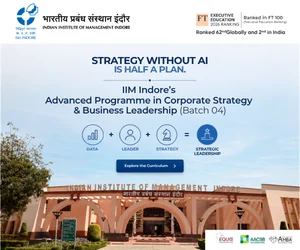
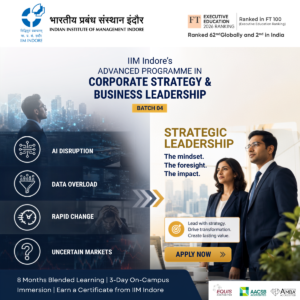
The five capabilities also provide a practical lens for assessing any executive programme. Applied to IIM Indore’s Advanced Programme in Corporate Strategy and Business Leadership (APCSBL), the lens shows coverage across strategy, finance, AI, organisational design and change management. The programme is built around the theme “Redefining Strategy and Leadership in the Age of AI”.
How the curriculum maps to the five capabilities
| Capability | Relevant APCSBL modules and topics |
|---|---|
| Problem framing and strategic questioning | Module 1: Leading with strategy and implementing business growth (strategic analysis, formulation and implementation). Module 6: Developing customer centricity (segmentation, customer journey, jobs-to-be-done). |
| Judgement under uncertainty | Module 5: Theory of Constraints for strategic decision-making (root-cause analysis, throughput-based decisions, systems tools). |
| Understanding data and AI | Module 7: Digital transformation and AI (data analytics and machine learning, generative AI, prompt engineering, agentic AI and ethical AI). |
| Translating technology into business value | Module 2: Managerial accounting and corporate valuation (strategic cost management, cost of capital, corporate valuation). Module 1: Digital platform business models, organic vs inorganic growth, mergers and acquisitions. |
| Leading organisational change | Module 3: How to become a transformational leader (change management, resistance, culture). Module 4: Organisational design. |
IIM Indore describes these as indicative topics. Faculty finalise each module based on the cohort’s learning needs and current developments in the field.
The peer group
- Size: across its first three batches, APCSBL brought together 162 participants from 33 industries and 159 organisations.
- Experience: participants averaged about 15.6 years of work experience.
- Seniority: around half held senior leadership titles such as Director, VP, GM, head of function or founder, based on self-reported titles when they joined.
- Sectors: participants have come from global technology and banking companies, as well as manufacturing, pharma, energy and public-sector organisations.
What completion gives you
Participants who meet the assessment requirements receive a Certificate of Completion from IIM Indore. They also become eligible to apply for IIM Indore’s Executive Education Alumni Status. This involves a separate application and fee, and the status is not conferred automatically on completion.
Who it may not suit
APCSBL is a certificate programme, not a degree, and it is not a technical AI course. Professionals who need an MBA or hands-on machine learning skills should look elsewhere, and there are other IIM Indore executive programmes built for different goals. Anyone who cannot protect Sunday mornings for eight months should weigh that honestly.
7. A practical next step: five questions to ask yourself
Before comparing programmes, spend 20 minutes on these:
- Which of my last three big decisions would have changed if analysis had cost nothing?
- Where in my business is AI changing what we choose to do, not just how fast we work?
- Could I evaluate an AI business case on financial terms, without relying on the vendor’s numbers?
- When did I last lead a change that altered how people actually work?
- Which of the five capabilities is my weakest, and how would I know?
If your honest answers point to one or two gaps, a targeted course or reading plan may be enough. If they point to three or more, especially across strategy, finance, and change, a structured programme that brings them together deserves serious consideration.
8. Conclusion: analysis is cheaper, judgement is not
AI is changing the economics of analysis, but it does not remove the need for strategic judgement. For senior professionals, the challenge is no longer simply learning how to use AI. It is understanding where AI can change the business and evaluating the choices it creates. It is also leading the organisation through the change that follows.
The leaders who do this well will not necessarily be the most technical people in the room. They will be the ones who ask the better question, test the assumptions behind the numbers, and take responsibility for the decision.
Ready to strengthen your strategic leadership?
If the five capabilities in this article match the gaps you want to close, IIM Indore’s Advanced Programme in Corporate Strategy and Business Leadership brings strategy, finance, change management, and AI together in one 8-month programme built for working professionals.
9. Frequently asked questions
What is strategic leadership in the age of AI?
It is the ability to set direction and make major business choices when AI produces much of the underlying analysis. It combines classic strategy work, such as choosing where to compete and what to stop doing, with the judgement to use AI-generated insight well and govern it responsibly.
Will AI replace strategic decision-making by senior leaders?
Current evidence does not suggest so. AI improves prediction and speeds up analysis, but decisions involving trade-offs, values, and accountability still rest with people. Research on consultants using GPT-4 also shows that relying on AI outside its strengths can reduce accuracy.
Do senior managers need to learn coding to lead AI adoption?
No. Senior managers need working AI fluency rather than engineering expertise. That means understanding what a model does, what data it relies on, where it tends to fail, and what governance it needs.
Is an executive programme worth it after 15+ years of experience?
It depends on your gaps. Experienced professionals often gain most from connecting strategy, finance, and change management and from working with peers of similar seniority. A programme is less useful if you need a formal degree or deep technical AI skills.
How is an executive programme in corporate strategy different from an MBA?
An executive programme is shorter and more focused, and it is designed to run alongside a full-time role. It usually leads to a certificate. An MBA covers broader management foundations over a longer period and leads to a degree.
Can I do a strategy and leadership programme while working full time?
Yes. Many programmes are designed for working professionals, often with weekend sessions. Check the total commitment, including assignments, assessments, and any campus module, not just the class schedule.
Who is the IIM Indore APCSBL programme designed for?
According to IIM Indore, it suits mid- to senior-level executives, entrepreneurs, corporate strategists and executive heads, and team leaders moving into strategic roles.
Applicants need at least five years of work experience and 50% marks in UG/PG, and admission is selective.
Sources and references
- McKinsey & Company, The State of AI (2026)
- BCG, Where’s the Value in AI? (2024)
- BCG press release, AI Adoption in 2024 (October 2024)
- Harvard Business School AI Institute, the jagged technological frontier study
- Dell’Acqua et al., HBS Working Paper 24-013 (2023)
- Michael E. Porter, What Is Strategy?, Harvard Business Review (1996)
- World Economic Forum, Future of Jobs Report 2025
- IIM Indore, APCSBL official programme page
- VCNow, IIM Indore APCSBL programme page
Also referenced: Ajay Agrawal, Joshua Gans, and Avi Goldfarb, Prediction Machines (Harvard Business Review Press); the Digital Personal Data Protection Act, 2023; and the Reserve Bank of India FREE-AI Committee Report (August 2025).
Last updated: 24 September 2026. Programme details are set by IIM Indore and subject to change.