

Key questions every professional must ask in the era of ESG, energy transition, and stakeholder capitalism
Why is sustainability leadership becoming a critical career skill?
For decades, the corporate mandate was straightforward: maximise shareholder value. That paradigm has shifted dramatically. Organisations today operate in an environment shaped by net-zero commitments, ESG disclosures, climate risk assessments, and stakeholder accountability.
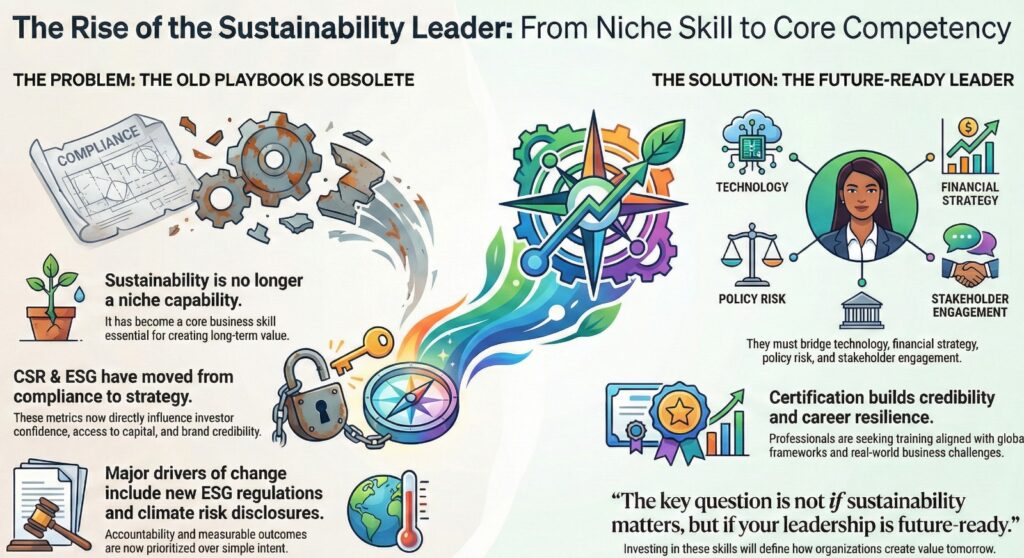
This transition from shareholder primacy to stakeholder capitalism is no longer theoretical. Climate risk is now widely recognised as financial risk, and leaders are expected to respond with strategy, not symbolism. For professionals across sectors, the real question is no longer if sustainability will matter—but how prepared they are to lead in this new reality.
Is ESG still just about compliance, or has it become strategic?
ESG is no longer a box to tick.
Historically, Corporate Social Responsibility (CSR) and ESG initiatives were often treated as peripheral activities—managed by public relations teams or confined to annual reports. That era has ended. Today, ESG is a core strategic and risk-management function, actively used by investors, regulators, and boards to assess long-term organisational resilience.
Sustainability performance has become a proxy for leadership quality. Organisations are expected not only to report outcomes, but to embed responsible business practices into decision-making, capital allocation, and long-term strategy. Leaders who fail to integrate ESG meaningfully risk losing both credibility and competitiveness.
What skills are required to lead the clean energy transition effectively?
The global energy transition demands more than technical expertise alone.
Whether you are an engineer, consultant, or sustainability professional, success in the renewable energy ecosystem requires a hybrid leadership skillset—a combination of technical understanding, financial acumen, policy awareness, and stakeholder management.
To drive impact, professionals must be able to:
- Translate renewable energy technologies into viable business cases
- Balance environmental goals with financial and regulatory realities
- Lead cross-functional teams through complex, long-term projects
This is why programmes such as the Advanced Programme in Renewable & Sustainable Energy Management—designed for professionals with a minimum of two years of work experience—focus on integrating technology, strategy, and leadership rather than treating them in isolation.
Who benefits most from developing sustainability and energy leadership skills?
Sustainability leadership is no longer limited to niche roles. It is increasingly relevant for professionals across functions, including:
- Engineers & Technologists translating technical specifications into board-level decisions
- Energy Auditors & Energy Managers securing executive buy-in for efficiency and transition projects
- Sustainability & ESG Professionals aligning reporting with corporate strategy
- Project Managers & Consultants navigating stakeholder complexity alongside technical execution
- Corporate Strategy Leaders & Entrepreneurs building businesses aligned with the green economy
As sustainability becomes embedded across organisations, leadership capability—not job title—defines impact.
How is executive education evolving to meet these new demands?
Executive education is undergoing its own transformation.
The most effective learning models now combine digital accessibility with high-impact, in-person engagement. The “high-tech meets high-touch” approach—featuring live online learning supported by a focused on-campus immersion—has become the benchmark for serious professional development.
This hybrid structure allows professionals to continue working while gaining:
- Real-time faculty interaction
- Peer learning and executive networking
- Practical validation of concepts through on-campus engagement
At Delhi Technological University (DTU), this model is delivered in partnership with VCNow, whose Direct-to-Device (D2D) and HD video-conferencing infrastructure enables an interactive, classroom-like experience across India.
Why does the DTU–VCNow collaboration matter for learners?
The strongest executive education outcomes emerge when academic rigour is combined with specialised delivery expertise.
In this collaborative model:
- DTU oversees curriculum design, assessments, and certification, ensuring academic depth and credibility
- VCNow enables seamless programme delivery through advanced learning technology and executive-friendly formats
This structure removes friction for busy professionals and ensures learning is practical, relevant, and immediately applicable.
For participants in the Leadership Programme in CSR, ESG & Corporate Sustainability – designed for mid-to-senior professionals with at least five years of experience—this collaboration enables deep engagement with global frameworks while remaining grounded in the Indian regulatory and business context.
What does this mean for your career in the long term?
Sustainability leadership and the clean energy transition are no longer emerging trends—they are strategic imperatives shaping the future of business, policy, and industry.
As regulations tighten and stakeholder expectations rise, organisations will increasingly rely on leaders who can navigate complexity, balance competing priorities, and create long-term value responsibly.
The real question professionals must ask themselves is this:
Is your career equipped to lead a sustainable future—or are you still relying on a legacy playbook?
Those who invest in building sustainability, ESG, and energy leadership capabilities today will define the organisations—and industries—of tomorrow.
FAQ

What is sustainability leadership and why is it important today?
Sustainability leadership refers to the ability to guide organisations through environmental, social, and governance (ESG) challenges while creating long-term value. Today, it is critical because businesses operate under increasing pressure from climate risk, regulatory requirements, and stakeholder expectations. Sustainability is no longer optional—it directly impacts financial performance, resilience, and credibility.
How is sustainability leadership different from traditional leadership roles?
Traditional leadership focused primarily on maximising shareholder value. Sustainability leadership, however, operates within the framework of stakeholder capitalism, balancing financial outcomes with environmental responsibility, social impact, and ethical governance. Leaders today are expected to integrate sustainability into strategy, decision-making, and risk management—not treat it as a peripheral initiative.
Is ESG still just about compliance, or has it become strategic?
ESG has evolved far beyond compliance. While it once functioned as a reporting or CSR exercise, it is now a core strategic function. Investors, boards, and regulators use ESG performance to assess long-term organisational resilience and leadership quality. Companies that fail to embed ESG into business strategy risk losing competitiveness and trust.
Why is ESG performance considered a measure of leadership quality?
ESG performance reflects how effectively leaders anticipate risk, allocate capital responsibly, and align business objectives with long-term societal expectations. Strong ESG outcomes indicate strategic foresight, accountability, and the ability to manage complexity—qualities that define effective leadership in today’s business environment.
What skills are required to lead the clean energy transition effectively?
Leading the clean energy transition requires a hybrid skillset. Professionals must combine technical understanding of renewable energy with financial acumen, regulatory awareness, and stakeholder management. The ability to translate technology into viable business cases and lead cross-functional teams is essential for driving sustainable impact.
Who benefits most from developing sustainability and energy leadership skills?
Sustainability leadership skills are valuable across functions and industries. Engineers, energy managers, ESG professionals, consultants, project managers, corporate leaders, and entrepreneurs all benefit from the ability to align sustainability goals with business strategy. Impact is defined not by job title, but by leadership capability.
How does the clean energy transition affect professionals beyond technical roles?
The clean energy transition is not limited to engineers or technologists. It affects professionals involved in strategy, finance, consulting, project management, and policy implementation. As sustainability becomes embedded across organisations, professionals must understand how environmental goals intersect with business, regulation, and long-term planning.
How is executive education evolving to support sustainability leadership?
Executive education is shifting toward hybrid learning models that combine digital accessibility with high-impact in-person engagement. This “high-tech meets high-touch” approach enables working professionals to gain real-time faculty interaction, peer learning, and practical insights while continuing their careers—making learning both flexible and effective.
Why does the DTU–VCNow collaboration add value to sustainability programmes?
The collaboration brings together academic rigour and advanced programme delivery. DTU ensures curriculum quality, assessment, and certification, while VCNow enables seamless learning through Direct-to-Device and HD video-conferencing technology. This structure ensures practical, executive-friendly learning grounded in real-world business and regulatory contexts.
How does sustainability leadership impact long-term career growth?
As sustainability and ESG become strategic imperatives, organisations increasingly seek leaders who can navigate complexity and create responsible long-term value. Professionals who invest in sustainability and energy leadership skills position themselves for future-ready roles, while those relying on legacy approaches risk career stagnation.