


Introduction to Reputation Capital

Reputation capital represents a company’s most valuable yet fragile asset in today’s digital landscape. It encompasses stakeholder perceptions, brand equity and long-term trust built over years but fragile enough to be eroded in moments. In the AI age, this capital faces amplified threats from algorithmic biases, deepfakes and hyper-speed information dissemination. Strategic leadership communication emerges as the critical board-level imperative, transforming reactive PR into proactive enterprise risk management.
Boards ignoring this shift risk cascading failures. Consider how AI accelerates reputation volatility: a single viral tweet amplified by algorithms can tank stock prices overnight. With C-suites citing AI as their top reputation worry—only 40% feel equipped—directors must prioritize structured communication frameworks. Drawing from elite programs like IIM Calcutta’s Advanced Programme in Strategic Leadership Communication (APSLC), leaders can master tools for narrative control and digital trust.
AI Accelerates Reputation Volatility
Artificial intelligence supercharges the speed and scale of reputational threats. Traditional risks like product recalls used to take weeks to escalate; AI compresses this to hours via generative tools and social amplification. Biased algorithms in hiring or lending spark public outrage, as seen in cases where facial recognition errors disproportionately affected minorities, leading to boycotts and lawsuits.
Recent S&P 500 disclosures provided by S&P Dow Jones reveal 38% of firms flagging AI-related reputation risks alongside cybersecurity. Volatility stems from AI’s “black box” nature—opaque decision-making erodes corporate credibility. Boards should incorporate AI governance into their oversight frameworks, leveraging predictive analytics to track and assess stakeholder sentiment across platforms. Proactive measures include ethical AI audits and transparent reporting, mitigating fallout before it trends globally.
Example: A major bank’s chatbot hallucinated false policy changes, sparking a 5% share dip in 24 hours. Swift CEO video responses restored calm, underscoring the executive communication strategy’s role.
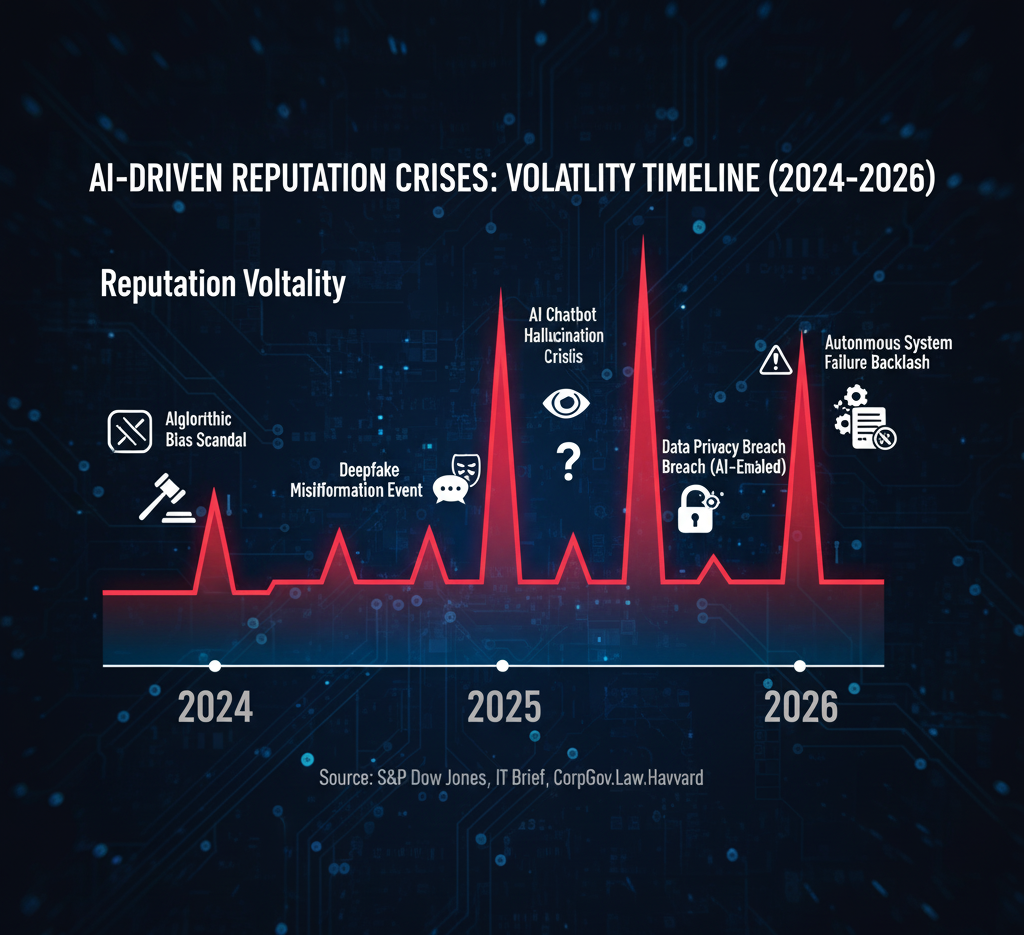
Collapse of Message Control in Hyper-Connected Ecosystems
The era of controlled corporate messaging ended with social media’s rise, but AI obliterates remnants. Generative models like large language models enable anyone to craft convincing narratives, blurring misinformation from facts. Hyper-connectivity—5G, real-time streaming—propels these at warp speed, with 78% of executives reporting revenue hits from viral false narratives.
Stakeholder trust management now battles algorithmic influence on brand reputation. Platforms’ feeds prioritize engagement over accuracy, turning minor gaffes into crises. CEOs face dilemmas in crisis communication: respond too slowly – damage compounds; respond too aggressively – it backfires.
Strategic narrative control demands agility. Leaders must cultivate digital trust in business through consistent, authentic voices across channels. APSLC modules on “Communication With(out) AI” equip executives to navigate this and also to craft counter-narratives.
Communication as Enterprise Risk Mitigation
View communication not as a support function but as core enterprise risk management. In volatile markets, reputation risk management integrates with financial and operational safeguards. AI-driven reputation risk tools—sentiment AI, predictive modelling—flag threats early, enabling pre-emptive leadership in uncertain markets.
Boards can operationalize this via dashboards tracking reputation KPIs like Net Promoter Scores fused with AI signals. When risks emerge, structured playbooks guide responses: assess, empathise, act, follow-up. This framework turns potential disasters into trust-building opportunities.
Real-World Application
During a 2025 supply chain AI glitch, a tech firm’s transparent board statement—admitting flaws and outlining fixes—boosted investor confidence by 12%, as per market data. Programs like APSLC emphasise data storytelling to make complex risks manageable, enhancing public accountability and leadership.
Board-Level Communication Strategies
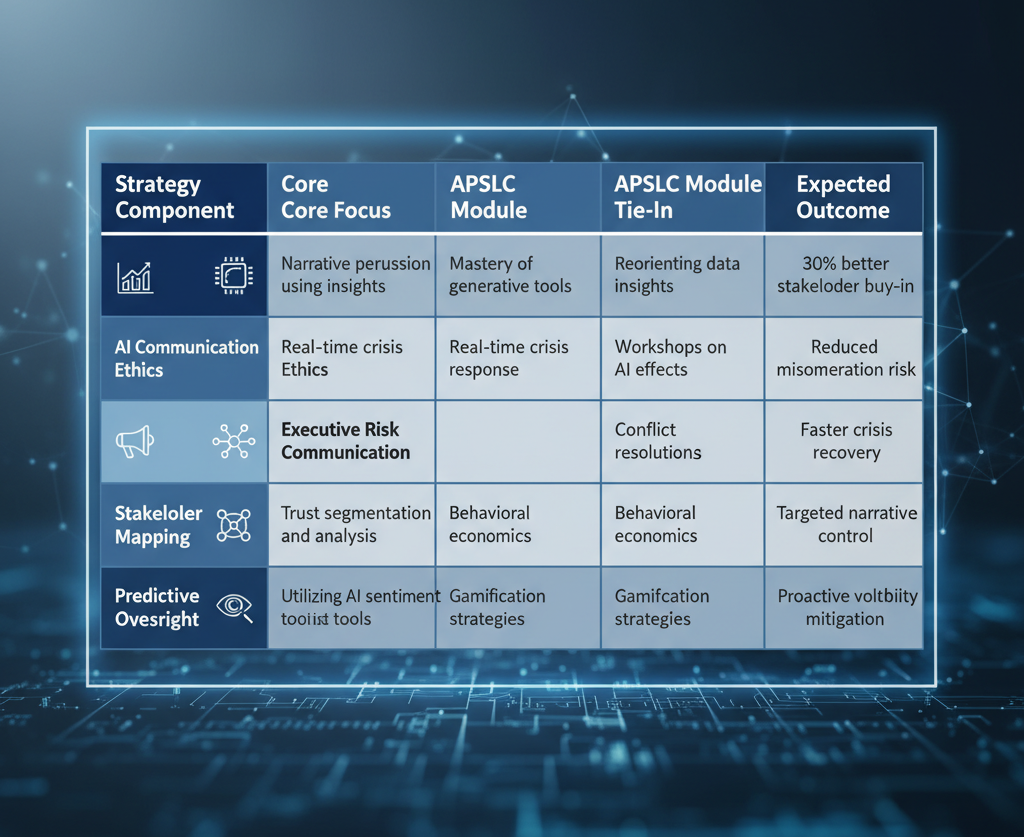
Boards should elevate strategic leadership communication to a core agenda priority. Corporate governance communication must now incorporate AI-era leadership training for directors. Key imperatives include
Embed Reputation in Governance
Treat reputation as a balance sheet line item, audited quarterly.
Build AI Competency
Mandate training on algorithmic influence and ethical deployment.
Develop Frameworks
Adopt APSLC-inspired models covering behavioural economics, gamification for engagement and crisis negotiation.
This table illustrates how structured approaches yield measurable resilience. IIM Calcutta’s triple-accredited status lends authority, with APSLC alumni reporting enhanced boardroom influence.
AI Governance and Leadership Frameworks
AI governance intersects with boardroom reputation strategy. Without it, firms face regulatory scrutiny—EU AI Act mandates high-risk disclosures. Leadership must champion “responsible AI,” communicating commitments transparently.
Frameworks blend tech with humanity: human-in-loop reviews for AI outputs, diverse training data to curb biases. Managing misinformation risk involves watermarking AI content and rapid fact-check protocols.
Actionable Insight
Implement a “Reputation War Room”—a cross-functional team with board observers, using AI for horizon scanning. APSLC’s curriculum on strategic narrative control prepares CXOs for this, emphasizing leadership in uncertain markets.
Case Studies: Success and Failure
Success – Tech Giant Turns Tide
In 2025, a CEO’s live AI ethics townhall quelled backlash over data privacy, regaining 15% consumer trust via authentic dialogue
Failure – Retailer’s Downfall
Ignored AI pricing algorithm complaints led to boycott, costing $200M. Absent board-level communication exacerbated the spiral.
FAQ

What is reputation capital and why is it increasingly vulnerable in the AI age?
Reputation capital is a company’s accumulated stakeholder perceptions, brand equity, and trust. In the AI age, it’s vulnerable due to amplified threats from algorithmic biases, deepfakes, hyper-speed information dissemination, and the “black box” nature of AI decision-making, which can rapidly erode trust and cause significant financial impact.
How does AI accelerate reputational volatility compared to traditional risks?
AI compresses the escalation time of reputational threats from weeks to hours. Generative AI tools and social amplification can turn minor incidents or misinformation into global crises almost instantly, making traditional crisis response methods too slow.
Why is “message control” collapsing in hyper-connected ecosystems with AI?
The rise of social media ended traditional message control, and AI further obliterates it by enabling anyone to craft convincing narratives (misinformation or otherwise) using generative models. Hyper-connectivity ensures these narratives spread at warp speed, making it challenging for companies to manage their brand story.
What role does strategic leadership communication play in mitigating AI-driven reputation risks?
Strategic leadership communication is a board-level imperative that transforms reactive PR into proactive enterprise risk management. It involves developing structured communication frameworks, ethical AI audits, transparent reporting, and agile narrative control to build and maintain digital trust.
How can boards operationalize communication as an enterprise risk management function?
Boards can operationalize this by embedding reputation as a core governance agenda item, building AI competency, utilizing AI-driven sentiment analysis and predictive modeling tools, and establishing structured playbooks for crisis response, including transparent executive statements.
What are some key board-level communication strategies for the AI era?
Key strategies include treating reputation as an audited balance sheet item, mandating training on algorithmic influence and ethical AI deployment, and adopting frameworks that cover data storytelling, AI communication ethics, executive risk communication, stakeholder mapping, and predictive oversight.
How do programs like IIM Calcutta’s Advanced Programme in Strategic Leadership Communication (APSLC) help leaders navigate these challenges?
The APSLC equips executives with tools for narrative control, digital trust, and real-time response. It covers modules in behavioural economics, gamification for engagement, crisis negotiation, and strategic narrative control, preparing leaders for complex AI-driven communication dilemmas.
What does “AI governance” mean in the context of boardroom reputation strategy?
AI governance involves transparently communicating commitments to “responsible AI,” implementing human-in-the-loop reviews for AI outputs, ensuring diverse training data to curb biases, and establishing protocols for managing misinformation, such as watermarking AI content.
Can you provide an example of successful communication during an AI-driven crisis?
A tech giant’s CEO held a live AI ethics townhall that effectively quelled backlash over data privacy by engaging in authentic dialogue, leading to a significant recovery in consumer trust.
What is a “Reputation War Room” and why is it crucial in the AI age?
A “Reputation War Room” is a cross-functional team, often with board observers, that uses AI for horizon scanning to detect emerging reputational threats early. It’s crucial because it enables proactive volatility mitigation and prepares CXOs for rapid, strategic responses to AI-accelerated crises.