

Executive Presence: What It Is, and How to Build It as a Leader
The research behind “executive presence,” why it influences promotion decisions, and practical, evidence-based ways to build it — with a look at how structured executive education can accelerate the process.
•
11 min read
•
Fact-checked against cited sources below
Executive Summary
Executive presence is the combination of how a leader carries themselves under pressure, communicates decisions, and shows up to others — and research on the topic has linked it to a meaningful share of promotion decisions at senior levels. It is not a fixed personality trait; it is a set of observable behaviours around gravitas, communication, and visibility that can be practised and improved. This guide breaks down what the research says, the signs a leader may be missing it, and practical habits to build it, along with how a structured programme such as the Advanced Programme in Strategic Leadership Communication (APSLC) from IIM Calcutta approaches it.
In This Article
What Is Executive Presence? (Quick Definition)
Executive presence is the ability to project confidence, credibility, and clarity in a way that makes others trust your judgement and want to follow your direction — particularly under pressure or in front of senior stakeholders. It shows up in how a leader speaks in a meeting, how they hold themselves during a difficult question, and how clearly they communicate a decision.
The term was popularised by workplace researcher Sylvia Ann Hewlett, whose study for the Center for Talent Innovation (now Coqual) surveyed senior executives on what separates leaders who get promoted from equally capable peers who don’t. Her conclusion: technical skill and results get a leader considered for promotion, but executive presence is frequently what tips the decision (Harvard Business Review, “Deconstructing Executive Presence,” 2012 — suggested source).
Importantly, executive presence is not the same as being extroverted, loud, or naturally charismatic. It is a learnable set of behaviours, which is why it is increasingly taught as a structured skill in leadership and communication programmes rather than treated as an innate trait.
The Three Components: Gravitas, Communication, Appearance
Hewlett’s research broke executive presence into three measurable components, weighted by how much senior leaders said each one mattered when judging a colleague’s presence:
Share of Executive Presence, by Component
Source: Sylvia Ann Hewlett / Center for Talent Innovation research, via Harvard Business Review, 2012 (suggested source — see footer).
Gravitas (the largest factor): How a leader behaves under pressure — staying composed in a crisis, showing sound judgement, being decisive, and projecting integrity and confidence without arrogance.
Communication: The ability to speak clearly and persuasively, read a room, listen actively, and get to the point rather than burying a recommendation in detail.
Appearance: The smallest of the three factors, though still relevant — being polished and appropriately put-together for the context, which the research notes acts more as a “threshold” or filter than a driver of presence on its own.
According to the same research, executives surveyed attributed roughly 26% of what it takes to get promoted to executive presence — placing it alongside performance and competency as a factor decision-makers weigh, rather than a “soft” afterthought (HBR, 2012 — suggested source). This is one reason communication-focused leadership programmes, including modules on public speaking, data storytelling, and persuasive argumentation, are built specifically around strengthening these components rather than teaching generic “soft skills.”
Why Executive Presence Matters for Career Growth
In Hewlett’s survey of senior executives, respondents attributed roughly 26% of what it takes to get promoted to executive presence — on par with substance, and separate from raw performance or competency (HBR, 2012 — suggested source).
Two equally skilled professionals can have very different trajectories once they reach a senior individual-contributor or department-head level. At that stage, technical competence is usually assumed — what differentiates candidates for CXO, director, or board-facing roles is how they communicate vision, handle scrutiny, and build trust with people who don’t yet know their work in detail.
This matters most in a specific set of high-stakes moments: presenting to a board or investors, leading a team through a crisis or restructuring, negotiating with a difficult counterparty, or representing the organisation publicly. In each of these, the underlying decision or data may be sound, but if it is not communicated with clarity and composure, it can fail to land — or fail to build the confidence needed to move forward.
For roles such as Corporate Communications, Marketing Communications, and senior sales leadership, executive presence is doubly important: it is not only a career differentiator but part of the job itself, since these functions represent the organisation’s voice to external stakeholders.
How Executive Presence Has Changed in the Remote and Digital Era
The original framework for executive presence was built around in-person, boardroom-style leadership. In a 2024 follow-up, Hewlett revisited the concept, arguing that a decade of change — remote and hybrid work, video-first communication, and shifting workforce expectations — has reshaped what “presence” looks like in practice (HBR, “The New Rules of Executive Presence,” 2024 — suggested source).
In practice, this means executive presence today also depends on skills that weren’t part of the original 2012 framework: how a leader communicates on video calls, how they build credibility through written and digital channels (email, Slack, LinkedIn), and — increasingly — how they use tools like AI-assisted communication without losing authenticity. This is why modern leadership communication training increasingly includes modules on digital communication and AI-assisted communication alongside traditional public speaking.
Signs You May Be Missing Executive Presence
Executive presence gaps are rarely about competence — they usually show up as a mismatch between how good someone’s thinking is and how that thinking comes across to others. Common signs include:
•Struggling to distil a complex recommendation into a clear, confident summary for senior stakeholders.
•Being over-prepared with detail but losing the room when a discussion moves off-script.
•Visibly losing composure — or over-explaining — when challenged or questioned in front of others.
•Feedback that describes the person as “capable but not yet ready” for a bigger role, without a specific skill gap named.
•Discomfort or lower impact when communicating across cultures, functions, or on camera versus in a familiar, in-person setting.
How to Build Executive Presence: 6 Practical Habits
Because executive presence is built from observable behaviours, it responds to deliberate practice. Six habits that map directly to the gravitas-communication-appearance framework:
Lead with the conclusion
State your recommendation first, then explain the reasoning — rather than building up to it. One of the most-cited ways to sound more senior in a meeting.
Practise structured public speaking
Presence under pressure is rehearsed, not innate. Regular practice in front of a real audience, with feedback, builds the composure that gravitas depends on.
Use data storytelling, not just data
Pairing numbers with a clear narrative of what they mean, and what should happen next, signals strategic thinking, not just analytical ability.
Get comfortable with silence
Pausing before answering a difficult question, instead of filling the gap with filler words, reads as confidence and control.
Adapt across cultures and functions
Leaders working across geographies or business units benefit from studying intercultural communication norms rather than assuming one style fits everywhere.
Seek structured, honest feedback
Presence is about how others perceive you, so self-assessment alone is unreliable. Recorded presentations and peer or faculty feedback close the gap faster than trial and error.
Practical note: Most of these habits are difficult to build alone because they depend on external feedback — which is why structured programmes that include video-graded presentations, case-based practice, and faculty or peer feedback tend to accelerate the process compared to reading or self-study alone.
Executive Presence vs. Confidence vs. Charisma
These three terms are often used interchangeably, but they are not the same thing — and confusing them is a common reason people focus on the wrong development area.
| Trait | What It Actually Is | Can It Be Learned? | Risk If Relied On Alone |
|---|---|---|---|
| Executive Presence | A combination of composure (gravitas), clear communication, and appropriate visibility, judged by others in high-stakes moments. | Yes — through practice, feedback, and structured training. | Low risk — it is the most holistic and evidence-linked of the three. |
| Confidence | An internal belief in one’s own ability or judgement. | Partially — grows with experience and preparation. | Confidence without communication skill can read as overconfidence or be invisible to others. |
| Charisma | A natural, magnetic likeability or energy in personal interactions. | Partially — but often treated as more innate than the other two. | Charisma without gravitas or substance can win a room short-term but erode credibility over time. |
How a Structured Programme Builds Executive Presence: APSLC by IIM Calcutta
Because executive presence depends on practice and feedback rather than theory alone, structured executive education is one of the more direct routes to building it — particularly for professionals who no longer receive regular, honest feedback on how they come across.
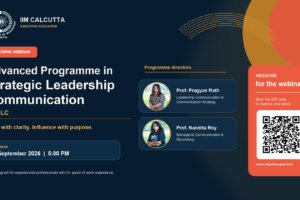
The Advanced Programme in Strategic Leadership Communication (APSLC), delivered by IIM Calcutta in partnership with VCNow, is built specifically around the components of executive presence described above — communication under pressure, persuasive argumentation, public speaking, data storytelling, and digital and cross-cultural communication — rather than generic soft-skills training.
Programme Snapshot (APSLC, Batch 8) — 6-Month Journey
Campus Module 1
3 days at IIM Calcutta — kickoff
Live Online Sessions
Saturdays, 10 a.m.–1 p.m. IST, with module-based evaluations
Campus Module 2
4 days — includes public speaking exam
Certification
Certificate of Completion + Alumni status from IIM Calcutta
Eligibility: Graduates (50% marks) with 5+ years of work experience.
Curriculum focus: Communication strategy, persuasive argumentation, public speaking, digital communication, intercultural communication, data presentations, conflict resolution and negotiation, digital-era storytelling, communication analytics, AI-assisted communication, and gamification.
Designed for: CEOs, Directors, CXOs, function/department heads, senior sales professionals, corporate and marketing communications professionals, management consultants, and team leaders preparing for larger leadership roles.
Credential: Certificate of Completion from IIM Calcutta, plus IIM Calcutta Executive Education Alumni status.
Full eligibility criteria, current fees, application deadlines, and batch dates are confirmed on the official programme page rather than repeated here, since these details are updated by the institute as each batch is scheduled.
Frequently Asked Questions
What is executive presence in simple terms?
It is the ability to project composure, clarity, and credibility to others — especially senior stakeholders — in a way that makes them trust your judgement. Research typically breaks it into three parts: gravitas (composure under pressure), communication (clarity and persuasion), and appearance (being appropriately polished for the context).
Is executive presence something you’re born with, or can it be learned?
It can be learned. While some people find aspects of it more natural, the components — staying composed under questioning, structuring a persuasive argument, reading an audience — are behavioural skills that improve with deliberate practice and feedback, which is the basis for most executive communication training.
What is the difference between executive presence and confidence?
Confidence is an internal belief in your own ability. Executive presence is how that (or its absence) is perceived externally, through composure, communication, and visibility. A person can be genuinely confident but still fail to project presence if they cannot communicate clearly under pressure.
Does executive presence still matter for leaders working remotely or hybrid?
Yes. Research on the topic has been updated specifically to address this, noting that video calls, written digital communication, and virtual collaboration have changed how presence is perceived, even as the underlying need for composure and clear communication remains the same.
How long does it typically take to build executive presence?
There is no fixed timeline, since it depends on the individual’s starting point and how much structured feedback they receive. Programmes built around repeated practice with feedback — such as recorded presentations and case-based exercises over several months — are generally more effective than sporadic, self-directed effort.
Who should consider a structured programme like APSLC to build executive presence?
It is designed for experienced professionals — typically CEOs, directors, CXOs, function heads, senior sales, corporate/marketing communications professionals, and consultants — who are already competent in their role but want a structured way to strengthen how they communicate and lead at a more senior or board-facing level. Full eligibility details are on the official programme page.
Sources & Further Reading
1. IIM Calcutta – Advanced Programme in Strategic Leadership Communication (APSLC), VCNow — official programme page (approved link).
2. Sylvia Ann Hewlett, “Deconstructing Executive Presence,” Harvard Business Review, 2012 — suggested source, recommend editorial review before publishing.
3. Sylvia Ann Hewlett, “The New Rules of Executive Presence,” Harvard Business Review, 2024 — suggested source, recommend editorial review before publishing.
Last updated: 10 September 2026