

HR Operations to Strategic HR: How to Make the Shift
How HR professionals can move from process execution to business-aligned, data-driven leadership roles.
Executive Summary
The transition from HR operations to strategic HR is really a shift from managing activities to influencing outcomes. Professionals who want to move into HRBP, senior HR leadership, or CHRO-track roles increasingly need stronger capability in workforce planning, analytics, business alignment, financial understanding, and leadership communication. The XLRI Executive Development Programme in Advanced Strategic HR and Analytics for HR Leaders is designed around those needs, with an 8-month format, live online weekend classes, a 4-day campus module, and modules covering strategic HR, HR analytics, ROI, dashboards, AI in HR, and CHRO capabilities.
Why strategic HR is now a career-defining move
Many HR professionals begin their careers in operations-heavy roles where success is measured by smooth execution, policy adherence, employee support, attendance systems, payroll coordination, onboarding, documentation, and issue resolution. Those responsibilities remain essential, but senior roles now require a broader ability to connect people decisions with growth, productivity, retention, workforce capability, and long-term organisational priorities.
That is why strategic HR has become one of the most important growth areas for experienced professionals. The official XLRI and VCNow programme pages position this shift around strategic foresight, advanced analytics, financial understanding, AI-enabled decision-making, and leadership readiness for high-impact HR roles such as CHRO.
Why experienced HR professionals should not delay this shift
The longer an HR profile remains limited to execution-only work, the harder it becomes to compete for leadership roles that demand strategic visibility. A structured move into analytics, workforce planning, compensation thinking, financial interpretation, and business-aligned HR strategy can materially improve readiness for HRBP, HR Head, L&D leadership, and CHRO-track opportunities.
What separates HR operations from strategic HR
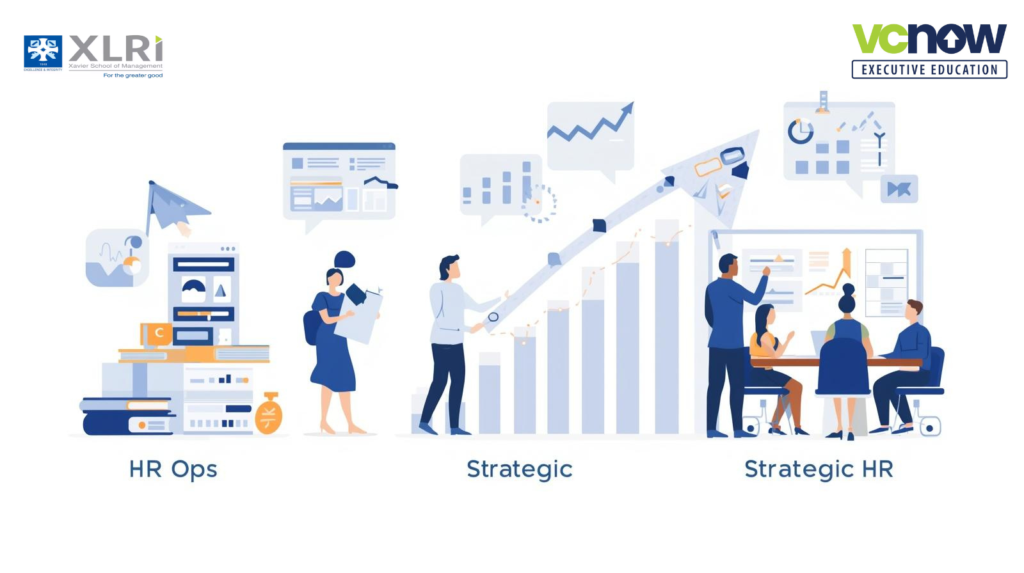
The difference is not that one is important and the other is not. The real difference is that operational HR keeps the organisation running smoothly, while strategic HR helps shape where the organisation is going and what talent capabilities it will need to get there.
A simple way to evaluate your current profile
Ask whether your work currently answers only “What happened?” or also answers “Why did it happen, what does it mean, and what should the business do next?” Strategic HR careers usually begin when professionals start answering the second set of questions with evidence, structure, and confidence.
Skills needed to transition into strategic roles
Operational excellence is a strong base, but it is not enough on its own for strategic advancement. The official programme curriculum makes it clear that the next layer of growth in HR leadership comes from combining strategic thinking, financial understanding, advanced analytics, data visualisation, workforce modelling, and leadership capability.
High-value skills that matter most
- Strategic business understanding, including strategic intent, business models, and value chain analysis.
- Financial literacy for HR decisions, including cost structures, budgeting, and ROI on human capital and employee benefits.
- Analytics capability across tools and techniques, including Power BI, R, SAS, Excel, visualisation, and interpretation.
- Predictive HR modelling for attrition, recruitment, workforce planning, and manpower optimisation.
- Compensation analytics, dashboard design, and reporting that improve decision quality.
- Leadership competencies required for CHRO-level roles, including communication, stakeholder management, and leadership pipeline development.
- Understanding the application of AI in HR decision-making and HR process transformation.
The capability gap most professionals face
A large number of HR professionals have solid practical experience but limited exposure to strategic analytics, cost-based thinking, forecasting models, and executive-level interpretation of people data. That gap often becomes the single biggest reason they are seen as operationally strong but not yet ready for broader strategic responsibility.
A practical roadmap to make the shift
A successful transition usually happens through visible, compounding steps. It is less about abandoning operations entirely and more about using operational knowledge as the base for strategic judgment.
Five practical moves
- Convert routine reporting into decision-ready dashboards that show trends, risks, and actions, not only static numbers.
- Start quantifying business impact through retention cost, hiring ROI, training impact, workforce gaps, and manpower allocation logic.
- Participate in cross-functional conversations involving business models, transformation priorities, and future capability needs.
- Take ownership of one strategic project, such as attrition analysis, workforce forecasting, compensation review, or succession-linked movement analytics.
- Invest in formal upskilling that gives structure, faculty guidance, peer learning, and recognised credential value. The official programme pages emphasise live lectures, case studies, workshops, group projects, capstone work, and networking as part of the learning model.
A realistic career pattern
In many cases, the professionals who progress fastest are not those doing the most tasks, but those who can frame HR issues as business issues. Once you can interpret attrition, productivity, compensation, engagement, and manpower needs through a strategic lens, your role starts to shift naturally from support executor to leadership contributor.
Why is this XLRI programme relevant now?
For experienced HR professionals who want a structured pathway into strategic roles, the XLRI Executive Development Programme in Advanced Strategic HR and Analytics for HR Leaders aligns closely with the transition requirements discussed above. The official programme pages state that it runs for 8 months, is delivered through live online Saturday sessions from 3 PM to 6 PM, includes a 4-day on-campus module, and awards a Certificate of Completion from XLRI to successful participants.
Modules especially relevant for HR professionals moving beyond operations
- Strategic Context for Data-Driven HR Decision.
- Strategic Transformation Through HR.
- Financial Aspects of HR Decisions.
- Application of Costing and ROI on Human Capital.
- HR Analytics tools and visualisation modules covering Power BI, R, SAS, Excel, charts, and AI-supported data work.
- HR Modelling, Advanced Predictive HR Models, and HR Forecasting and Manpower Optimization.
- Compensation Analytics, HR Dashboard and Report Writing, Competencies and Capabilities for CHROs, and Application of AI in HR decision making.
Why this can create urgency for the right candidate
For professionals who already meet the experience threshold, waiting too long to build strategy and analytics capability can mean missing out on better-positioned career transitions. The programme pages present this course as a pathway for ambitious HR professionals who want to become influential leaders and drive measurable results with a strategic, data-driven mindset.
Build the capabilities that strategic HR roles now demand
If your goal is to move beyond HR operations into business-facing, analytics-driven, leadership-ready roles, this programme offers a verified curriculum built around that exact transition. The combination of strategic HR, analytics, ROI, forecasting, dashboards, AI, and CHRO-oriented modules makes it particularly relevant for experienced professionals planning their next move.