The Difference Between Business Analytics and Data Science, Explained Simply
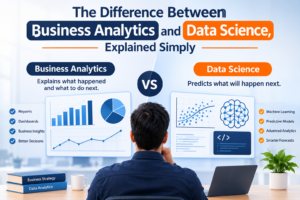
Business analytics uses data to explain what happened and decide what to do next. Data science builds code and models that predict what will happen. Most companies need both, and the managers who understand both are the ones who lead data teams.
Updated: 10 November 2026
Read time: 9 minutes
By VCNow Editorial Team
The short answer
The main difference between business analytics and data science is depth and direction. Business analytics works mostly with structured business data and statistics to answer “what happened, and what should we do?” Data science uses coding, machine learning and both structured and unstructured data to answer “what will happen next?”
Where VCNow fits: If you want to learn both and lead data teams, IIM Nagpur’s Blended MBA in Data Science & Management covers data science, AI and predictive and prescriptive analytics inside a full IIM MBA, for ₹12,10,000. Applications close on 30 November 2026.
What this article covers
1. What is business analytics, and what does a business analyst do?
Business analytics is the use of data and statistics to understand how a business is performing and how to improve it. A business analyst studies sales, costs, customers and processes, finds patterns, and turns them into clear recommendations for managers.
On a typical day, a business analyst pulls data with SQL or Excel, builds dashboards in tools such as Tableau or Power BI, and presents findings to business teams. Much of the job is communication: asking the right questions, explaining numbers in plain words, and helping teams agree on the next step.
Key skills include statistics, Excel, SQL, data visualisation, business knowledge and storytelling. Coding helps but is not central. According to PayScale India, business analysts earn about ₹6.9 lakh a year on average.
2. What is data science, and what does a data scientist do?
Data science combines statistics, programming and machine learning to find patterns in large and messy data sets. It works with structured data such as sales tables and with unstructured data such as text, images and app logs.
A data scientist cleans raw data, writes code in Python or R, builds models that predict outcomes, and tests whether those models work. The work often feeds into products, such as a recommendation engine or a fraud alert system, rather than into a single report.
What data scientists say about their work
After interviewing 35 data scientists for Harvard Business Review in 2018, Hugo Bowne-Anderson concluded that “data science is about infrastructure, testing, using machine learning for decision making, and data products.” In other words, data science builds systems, while business analytics mostly guides individual decisions.
Key skills include Python or R, SQL, statistics, machine learning and data engineering basics. PayScale India puts average data scientist pay at about ₹10.1 lakh a year, higher than business analysts because the technical skills are rarer.
3. The four types of analytics: where each field works
A simple way to see the difference is the four-step analytics ladder, a model popularised by the research firm Gartner. Each step answers a harder question and creates more value.
The analytics ladder
Each step answers a harder question. Pills show which field usually owns the step.
Framework: the four types of analytics, popularised by Gartner. Examples and field ownership are VCNow’s simplified view; real teams often overlap.
Business analytics lives mostly on the first two steps and reaches into the fourth when it turns findings into decisions. Data science powers the third step and much of the fourth. That is why the strongest data leaders understand the whole ladder, not just one part of it.
4. Same business problem, two approaches
Here is a hypothetical example. An online grocery app in India has 2 lakh paying subscribers and loses about 6% of them every month. The leadership team asks: “Why are customers cancelling, and how do we stop it?”
One problem, two approaches
A hypothetical online grocery app with 2 lakh subscribers and 6% monthly cancellations.
Hypothetical example created by VCNow for illustration. All figures are invented to show the method.
Neither approach is “better”. The business analyst finds a fixable cause quickly, while the data scientist builds a tool that keeps working every week. In practice, the company gets the best result when someone who understands both decides where to spend the budget.
5. Difference between business analytics and data science at a glance
| Factor | Business analytics | Data science |
|---|---|---|
| Main question | What happened, why, and what should we do? | What will happen, and how can we automate it? |
| Data types | Mostly structured data (tables, reports) | Structured and unstructured data (text, images, logs) |
| Coding | Light: Excel, SQL | Heavy: Python, R, machine learning libraries |
| Core methods | Statistics, dashboards, business cases | Algorithms, machine learning, experiments |
| Typical tools | Excel, SQL, Tableau, Power BI | Python, R, SQL, Spark, cloud platforms |
| Top industries | Finance, healthcare, marketing, retail, supply chain, telecom | E-commerce, finance, manufacturing, tech and AI products |
| Typical roles | Business analyst, BI analyst, analytics consultant | Data scientist, ML engineer, data engineer |
| Average pay in India (PayScale) | About ₹6.9 lakh a year (business analyst) | About ₹10.1 lakh a year (data scientist) |
Sources: adapted from UT Dallas Jindal School’s comparison (updated April 2025); pay from PayScale India (2026), base pay only.
Both fields are growing. The WEF Future of Jobs Report 2025 expects big data specialist roles to grow by 113% between 2025 and 2030, and roles for data analysts and scientists by 41%.
6. Which is better for you, and where can you learn both?
If you come from sales, finance, marketing or operations, business analytics is the easier first step, because your business knowledge counts for a lot. Engineers and IT professionals who enjoy coding may find data science a better fit. And if your goal is to lead data teams, you need enough of both to manage the people who do each job.
Here is how the main options on VCNow line up.
| Programme | What it covers | Credential | Duration | Fee | Experience |
|---|---|---|---|---|---|
| IIM Nagpur Blended MBA in Data Science & Management | Both: data science, AI, predictive and prescriptive analytics, plus a full MBA | MBA degree + IIM Nagpur Alumni status | 2 years, blended | ₹12,10,000 all-in | 3+ years |
| IIM Indore Integrated Programme in Business Analytics | Business analytics | Certificate | 10 months | ₹3,20,000 + GST | 2+ years |
| IIM Calcutta Advanced Programme in Data Sciences | Data science | Certificate | 12 months | ₹4,80,000 + 18% GST | 3+ years |
| Dr. D.Y. Patil Vidyapeeth Online MBA | Business Analytics or AI & ML specialisation | Online MBA degree (AICTE & UGC approved) | 2 years, fully online | ₹1,89,400 | Check with institute |
Source: programme details from learn.vcnow.in, as of 10 November 2026.
What the table tells you
The IIM certificates teach one side well and cost less, and Dr. D.Y. Patil’s online MBA is the cheapest degree. However, only IIM Nagpur covers the full analytics ladder, from analytics to data science and AI, inside a full IIM MBA with campus time.
Learn both sides of data, then lead
Study analytics, data science and AI inside a full IIM Nagpur MBA, on weekends, while you keep your job. Applications close on 30 November 2026.
7. Frequently asked questions
What is the main difference between business analytics and data science?
Business analytics uses statistics and mostly structured business data to explain what happened and decide what to do. Data science uses coding, machine learning and both structured and unstructured data to predict what will happen and build data products.
Which pays more in India, business analytics or data science?
Data science pays more on average. PayScale India puts average base pay at about ₹10.1 lakh a year for data scientists and about ₹6.9 lakh for business analysts. Leadership roles in both fields pay much more.
Do business analysts need to know coding?
Not much. Most business analysts use Excel, SQL and dashboard tools such as Tableau or Power BI. Basic Python helps, but strong statistics, business knowledge and communication matter more.
Can a business analyst become a data scientist?
Yes. Many business analysts move into data science by learning Python, machine learning and more advanced statistics. Their business knowledge is a real advantage, because it helps them choose problems that matter.
Where can I learn both business analytics and data science?
IIM Nagpur’s Blended MBA in Data Science & Management covers data science, AI, and predictive and prescriptive analytics inside a full IIM MBA. It costs ₹12,10,000, needs 3+ years of experience, and applications close on 30 November 2026.
Sources and references
IIM Nagpur Blended MBA in Data Science & Management: learn.vcnow.in/programmes/iim-nagpur-mba-data-science-management
UT Dallas Jindal School, The Difference Between Business Analytics and Data Science (outline reference): jindal.utdallas.edu
Harvard Business Review, What Data Scientists Really Do, According to 35 Data Scientists (2018): hbr.org
PayScale India salary pages: Business Analyst, Data Scientist
World Economic Forum, Future of Jobs Report 2025, via Euronews: euronews.com
Details for IIM Calcutta, IIM Indore and Dr. D.Y. Patil Vidyapeeth programmes: learn.vcnow.in
Last updated: 10 November 2026. Fees and dates are set by the institutes and subject to change.