

Investing in the Advanced Programme in Renewable & Sustainable Energy Management enables professionals to gain a comprehensive understanding of renewable energy technologies, sustainability frameworks, and project leadership aligned with India’s clean energy transition and net-zero goals. The programme offers a structured, practice-oriented curriculum delivered by experienced DTU faculty through live online sessions, real-world case studies, simulations, and a capstone project, ensuring immediate workplace applicability. The blended learning format, combined with an on-campus immersion and DTU Executive Alumni status, provides academic rigor, flexibility for working professionals, and valuable peer and faculty engagement, making it a strategic investment for those seeking to build expertise and leadership capability in the green and sustainable energy sector.


Delhi Technological University’s
Advanced Programme in Renewable and Sustainable Energy Management
Batch No: 01
Build Clean Energy Systems Shaping the Future
Programme Highlights

Eligibility
Open to Graduates and Diploma Holders with a minimum of 2 years of work experience

Duration
6 months
Commencement
24 May, 2026
Last date to Apply
31 March, 2026

Mode
Blended Learning (Online + 3 Days In-Campus module at Delhi Technological University)

Sessions
Sunday (9:30 AM – 12:30 PM)

Fees
INR 1,60,000 + GST
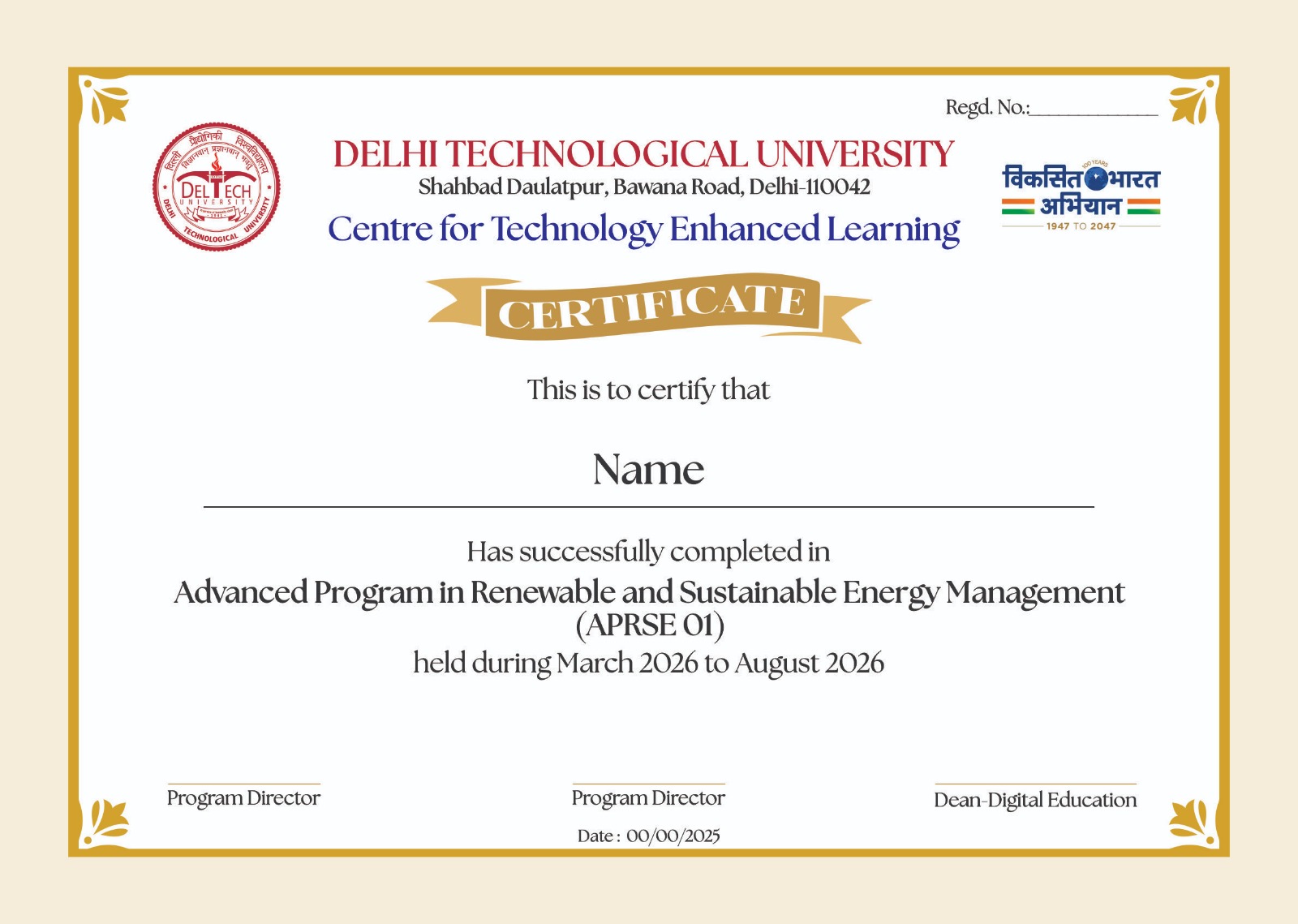
Post Programme completion, the candidate will receive Delhi Technological University’s Completion Certificate and Executive Education Alumni Status.
Programme Overview
In India, renewable and sustainable energy initiatives are no longer peripheral. With over 200 GW of installed renewable capacity and ambitious national targets for the coming decade, energy-related decisions are increasingly being taken across organisations, with clear expectations for planning, evaluation, and delivery. As activities scale, professionals must engage simultaneously with technical understanding, financial implications, policy considerations and implementation realities.
How do professionals develop a clear, end-to-end understanding of renewable and sustainable energy initiatives while balancing these interconnected considerations?
The Advanced Programme in Renewable & Sustainable Energy Management (APRSEM) at Delhi Technological University (DTU) is designed to address this need through a structured, application-oriented curriculum. This 6-month programme equips participants with practical insights into renewable energy technologies, energy storage, grid integration, policy and regulatory environments, project planning and energy economics, enabling informed decision-making across the clean energy value chain.
Delivered through a live online learning format, complemented by a 3-day campus immersion at DTU, this career-enhancing programme is designed for engineers, managers, policy professionals, consultants, and practitioners working across energy, infrastructure, utilities, and related sectors who seek a structured understanding of clean energy systems and transition dynamics.
Consult Our Academic Advisor
Programme Objective
- Develop a strong foundation in renewable energy technologies, including solar, wind, bioenergy, storage, and green hydrogen.
- Enable the planning, evaluation, and management of renewable energy projects.
- Integrate sustainability, ESG, SDGs, and circular economy principles into energy strategy.
- Build data-driven decision-making skills using analytical and financial tools.
- Prepare participants for leadership roles in the green and sustainable economy.
What Does This Programme Cover?
- Key Topics
- • Global & Indian Energy Landscape
- • Transition to Net Zero
- • Renewable Energy Sources: Solar, Wind, Hydro, Biomass, Geothermal
- • Sustainable Energy Policies & Regulations
- • Economics of Renewable Energy
- Learning Outcomes
- • Understand the key drivers of renewable energy adoption
- • Build foundational technical and economic knowledge of renewable energy systems
- • Interpret national and global energy strategies and targets
- Practical Components
- • Case Study: India’s Renewable Energy Targets
- • Tool Session: Basic LCOE Calculation (Solar & Wind)
- Key Topics
- • Solar PV Technology & Components
- • Rooftop & Utility-Scale Solar
- • System Sizing, Shadow Analysis, Performance Ratios
- • Financial Modelling for Solar Projects
- • Solar O&M, Remote Monitoring, and Automation
- Learning Outcomes
- • Design and evaluate solar PV projects
- • Perform energy yield estimation
- • Understand CAPEX, OPEX, ROI, and payback metrics
- Practical Components
- • Software Session: Helioscope / PVSyst Basics
- • Mini Project: 100 kW Solar System Feasibility Report
- Key Topics
- • Wind Resource Assessment
- • Wind Turbine Technologies
- • Small Hydro Plants & Site Selection
- • Biomass & Waste-to-Energy Technology
- • Hybrid RE Systems (Solar + Wind + Storage)
- Learning Outcomes
- • Evaluate wind, hydro, and biomass projects
- • Interpret resource data and environmental constraints
- • Integrate hybrid renewable energy solutions
- Practical Components
- • Software Session: WindPro / OpenWind Demo
- • Case Study: Hybrid Renewable Energy Parks in India
- Key Topics
- • Battery Technologies (Li-ion, Flow, Advanced Chemistries)
- • Storage Economics & Use Cases
- • Hydrogen Production, Electrolysers, Fuel Cells
- • RE Grid Integration, Smart Grids, EV Charging Infrastructure
- Learning Outcomes
- • Compare different storage technologies
- • Understand hydrogen’s role in decarbonisation
- • Address grid stability & intermittency challenges
- Practical Components
- • Simulation: Battery Sizing for Solar + Storage
- • Case Study: National Green Hydrogen Mission
- Key Topics
- • ESG Frameworks (Global Reporting Initiative, BRSR, SASB)
- • Corporate Sustainability Strategy
- • Carbon Accounting, GHG Protocols, CDP
- • Industrial Energy Efficiency & Energy Audit
- • Circular Economy & Sustainable Operations
- Learning Outcomes
- • Build sustainability roadmaps
- • Perform carbon footprint assessments
- • Align projects with ESG standards
- Practical Components
- • Activity: Carbon Footprint Calculation for a Facility
- • Case Study: ESG Reporting in Manufacturing
- Key Topics
- • Renewable Energy Project Lifecycle
- • Risk Assessment & Regulatory Compliance
- • Project Finance & PPP Models
- • Energy Markets, Trading & Open Access
- • Leadership in Clean Energy Transition
- Learning Outcomes
- • Manage end-to-end RE projects
- • Understand bidding, procurement & financing
- • Lead organisational sustainability initiatives
- Practical Components
- • Tool: Financial Modelling in Excel
- • Policy Simulation: Drafting RE Procurement Strategy
- Participants will complete a real-world project, such as:
- • Feasibility study for a corporate solar rooftop
- • Energy transition roadmap for an SME
- • Carbon footprint & ESG improvement plan
- • Design of a hybrid RE (solar + storage) microgrid
- • Green hydrogen pilot proposal
- Includes presentation to an expert panel for certification.
Programme Structure
Programme Structure
The Advanced Programme in Renewable & Sustainable Energy Management is structured as a six-month executive education programme delivered through a blended format comprising live online sessions and an on-campus immersion module. The programme consists of weekly classes conducted once a week, primarily on Saturdays, supported by structured assessments, assignments, and a capstone project spread across the duration of the programme. The total learning engagement includes 84 hours, with 72 hours of live online instruction and 12 hours of in-campus learning towards the end of the programme, enabling both conceptual understanding and experiential exposure .
Curriculum Structure
The curriculum is organized into six comprehensive modules that progressively build knowledge across renewable and sustainable energy domains. It begins with fundamentals of renewable and sustainable energy and advances through solar energy systems, wind, hydro and bioenergy systems, energy storage and green hydrogen, sustainability and ESG frameworks, and finally project management, policy, finance, and leadership. Each module integrates key topics, defined learning outcomes, and practical components such as case studies, simulations, software demonstrations, and hands-on exercises. The curriculum culminates in a real-world capstone project that requires participants to apply their learning to practical organizational or industry scenarios .
Programme Objectives
The programme aims to develop a strong foundation in renewable energy technologies including solar, wind, bioenergy, storage, and green hydrogen. It seeks to equip participants with the ability to plan, evaluate, and manage renewable energy projects while integrating sustainability principles such as ESG frameworks, SDGs, and circular economy concepts into energy strategy. The programme also focuses on building data-driven decision-making capabilities using analytical and financial tools and preparing participants for leadership roles in the green and sustainable economy .
Programme Delivery Methods
The programme is delivered through live faculty-led online sessions using VCNow’s Direct-to-Device (D2D) technology platform, ensuring interactive and real-time engagement. The pedagogy includes case studies, simulations, quizzes, in-class exercises, individual and group assignments, and mid-term and end-term evaluations. Faculty provide continuous feedback to support applied learning. In addition to online delivery, the programme includes an on-campus immersion module and a capstone project evaluated by experts, enabling participants to directly apply theoretical concepts to real-world energy and sustainability challenges .
Campus Immersion
The programme includes a three-day on-campus immersion module conducted at Delhi Technological University at the early stages of the programme. This campus module is designed to provide participants with an immersive academic environment, direct interaction with faculty, and exposure to peer learning and institutional facilities. The on-campus component complements the online learning experience and forms an integral part of the programme’s blended delivery approach .
The Advanced Programme in Renewable & Sustainable Energy Management is a six-month blended executive programme combining live online learning with an on-campus immersion. It features a structured, multi-module curriculum covering renewable energy technologies, sustainability frameworks, policy, finance, and leadership, supported by case studies, practical tools, and a capstone project. Delivered through interactive, faculty-led sessions by DTU, the programme equips participants with the skills to plan, evaluate, and lead renewable energy initiatives, while the campus immersion provides direct academic engagement and experiential learning.
Programme Benefits
Who is this Programme for?
- Engineers, Technologists
- Sustainability & ESG Teams
- Energy Managers & Auditors
- Project Managers, Consultants
- Corporate Strategy & Operations Leaders
- Entrepreneurs entering Clean Energy
Why should you invest in this programme?
Alumni Status
Successful graduates will be granted Executive Alumni Status of Delhi Technological University, providing access to a prestigious network of professionals.
- Expertise: Master renewable energy tech, global policies, and market dynamics.
- Finance: Gain practical skills in project viability, cost structures, and risk assessment.
- Leadership: Build capabilities to lead and implement sustainable initiatives.
- ESG & Compliance: Navigate sustainability frameworks and regulatory reporting.
- Application: Apply skills to real-world scenarios through a hands-on capstone project.
- Certification: Earn a DTU certificate to accelerate your career in clean energy.
Application & Admission Process
Admission Criteria
- Selection is based on academic background, professional experience, and overall suitability for the programme.
- Applicants are evaluated on their interest in Renewable & Sustainable Energy Management
-related roles and their ability to benefit from the programme.
- Final admission is subject to submission and verification of required documents and payment of programme fees.
-related roles and their ability to benefit from the programme.
Eligibility Criteria
- For Indian Participants – Graduates (10+2+3) or Diploma Holders (only 10+2+3) from a recognized university (UGC/AICTE/DEC/AIU/State Government) in any discipline.
- For International Participants – Graduation or equivalent degree from any recognized University or Institution in their respective country.
- Working Professionals with 2 years of work experience
Certificate
Assessment & Evaluation
Assessment is continuous and practice-oriented, comprising quizzes, case studies, assignments, class participation, and project work as decided by the faculty. These components are designed to help participants apply programme concepts to real-world renewable energy and sustainability scenarios.
The capstone project forms a key part of the assessment process, allowing participants to work individually or in groups on real-world problems and present their findings for expert evaluation.
Evaluation is conducted through online exams, case analysis, assignments, and project presentations, based on faculty discretion and defined pass criteria. The evaluation framework ensures both conceptual understanding and practical application of learning.
A minimum of 75% attendance is mandatory for certification eligibility. Participants who meet the attendance and evaluation requirements receive a Certificate of Completion, while others with requisite attendance receive a Participation Certificate.
Consult Our Academic Advisor
Important details
31 March, 2026
Application closure date24 May, 2026
Programme start dateNovember, 2026
Programme end dateSunday 9:30 AM – 12:30 PM IST
Batch timings
Programme Directors

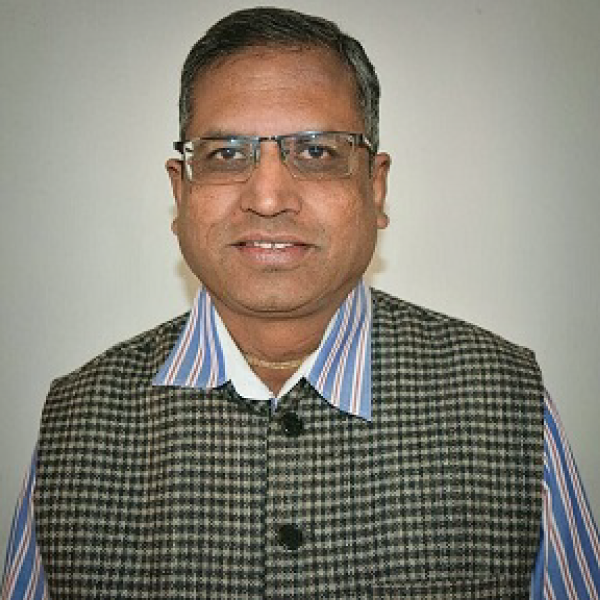
Prof M Rizwan
Professor in the department of Electrical Engineering at Delhi Technological UniversityProf. Rizwan did his post-doctoral research at Virginia Polytechnic Institute and State University, USA. He has more than 23 years of teaching and research experience. Dr. Rizwan has successfully completed five research projects in the area of renewable energy systems and published and presented more than 220 research papers in reputed international and national journals, including IEEE Transactions and conference proceedings. Presently, he is working on one international and one national research project in the area of solar PV and EVs. Dr. Rizwan has authored one book for CRC Press, USA, and edited one book for AIP Publishing, USA. He is the recipient of Raman Fellowships for Post-Doctoral Research for Indian Scholars in USA, DST Start Up Grants (Young Scientists), and many more. His area of interest includes soft computing applications in power engineering, renewable energy systems, building energy management, smart grid, etc.
Prof Neeraj Sharma Professor
adjunct faculty in the Delhi School of Management at Delhi Technological UniversityProf Neeraj Sharma is often referred to as the “Bheeshma Pitamah” of the Technology Based Executive Management Education. He holds a PhD degree in Management Sciences from IIT Delhi and a M Tech from IIT Kharagpur. He is the recipient of the Institute Silver Medal at IIT Kharagpur. Prof Sharma carries more than 30 years of corporate experience in senior positions with the marquee companies like Usha Martin, Tata Infotech, Hughes, NIIT, upGrad, etc. He has served as Director and Cofounder of myDiksha and the founding CEO of Prayogtvisha. He also holds more than 3 years of academic experience too. Prof Sharma has published papers in Indian and International Journals, in addition to being the author of chapters in some reference books. He has been studying and teaching courses on Indian Knowledge Systems. He has also authored a book on Hindi poetry – Man Manthan.
Fee Structure
| FEE TOWARDS | AMOUNT |
|---|---|
| Application Fee | ₹2,000 + GST |
| Installment I (Within 7–10 days of Offer Letter) | ₹55,000 + GST |
| Installment II (On or before 10 July 2026) | ₹55,000 + GST |
| Installment III (On or before 10 August 2026) | ₹50,000 + GST |
| Programme Fee | ₹1,60,000 + GST |
Pay in 3 easy installments
FAQs

What is the advanced programme in renewable & sustainable energy management?
This is a premier 6-month executive education programme designed by DTU to equip senior leaders with the strategic, technical and financial expertise needed to lead the energy transition. It covers renewable energy systems, decarbonization strategies, ESG standards, and the role of AI in sustainable energy management.
Who is this DTU renewable & sustainable energy management programme intended for?
The Renewable & Sustainable Energy Management programme is specifically designed for:
Senior Managers & CXOs leading energy or sustainability departments.
Compliance & Risk Officers focused on energy policy and ESG reporting.
Sustainability Professionals driving environmental impact initiatives.
Board Members & Strategy Leaders looking to integrate green energy into corporate governance.
What is the duration and format of the sustainable and renewable energy course?
The Delhi Technological University’s sustainable and renewable energy course lasts 6 months and follows a Blended Learning model. This includes:
67 hours of Live Online Sessions (typically held on Saturdays, e.g., 6:00 PM – 9:10 PM IST).
3-Day Campus Immersion at Delhi Technological University (DTU) to foster peer networking and hands-on learning.
What are the key modules covered in the DTU renewable energy course?
The sustainable & renewable energy course curriculum is divided into strategic blocks, including:
Fundamentals: Overview of the green economy and energy systems.
Renewable Tech: Deep dives into Solar, Wind, Hydro, and Bioenergy.
Future Tech: Energy Storage, Green Hydrogen, and Grid Integration.
Leadership & Strategy: ESG standards, Carbon Finance, Decarbonization strategies, and AI-driven energy optimization.
What are the eligibility criteria of this renewable energy programme in India?
Indian Applicants must be Graduates (10+2+3) or Diploma Holders (only 10+2+3) from a recognized university (UGC/AICTE/DEC/AIU/State Government) in any discipline.
International Participants – Graduation or equivalent degree from any recognized University or Institution in their respective country.
Working Professionals with 2 years of professional work experience
Still have questions?
Consult our Academic Adviser

 Request a Call Back
